The claim was bold: with this method, output quality can jump from an average 6.2/10 to a sharp 9.1/10.
But here’s the interesting part: this is not some secret backdoor shared by engineers at OpenAI or Anthropic. It’s an ancient idea from Socrates (~400 BC) applied smartly to modern AI tools like ChatGPT, Claude, Gemini, or Grok. And the best news—it’s so simple that you can start using it in the next 10 minutes.
What Is Socratic Prompting?
Most people use AI in a very straightforward way:
- “Write a value proposition for my AI tool.”
- “Create a content calendar for LinkedIn.”
- “Analyze this customer feedback.”
This is traditional prompting: you tell the AI what to do.
Socratic Prompting flips this. Instead of giving direct instructions, you ask a sequence of guiding questions that force the AI to think before it writes.
Example:
- Traditional: “Write a value proposition for my AI tool.”
- Socratic: “What makes a value proposition compelling to B2B buyers? What emotional and logical triggers should it hit? Now apply that framework to an AI analytics tool.”
By asking questions first, you’re activating the model’s internal reasoning—similar to how a human expert would first brainstorm, structure, and then write.
Key idea: Socratic Prompting turns the AI from a “do-as-told assistant” into a “thinking collaborator.”
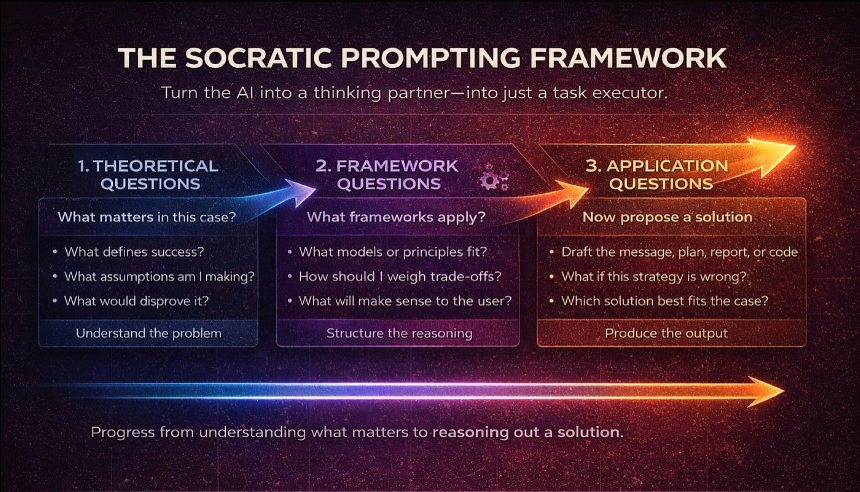
The 3-Part Socratic Framework
You don’t need a PhD in philosophy to use this. A simple three-step question structure is enough.
You can think of it as:
- Theoretical Question – “What makes [output type] effective?”
- Framework Question – “What principles or frameworks apply here?”
- Application Question – “Now apply those insights to [my specific case].”
This is the secret sauce that makes it work consistently.
Why Socratic Prompting Works So Well
Large language models (LLMs) like ChatGPT or Claude are trained on billions of examples of explanations, reasoning steps, and analytical text.
When you give a short, direct command:
- The AI optimizes for speed
- It often produces shallow, generic, “good-enough” content
When you ask layered questions instead:
- The AI is nudged into a deeper reasoning mode
- It surfaces patterns, frameworks, and nuances it has seen in its training data
In other words:
- Direct instructions → junior analyst dumping quick output
- Socratic questions → senior strategist unpacking the problem, then answering
This is exactly why people report a visible jump in quality—from 6.2/10 to 9.1/10—without changing tools, only changing how they prompt.
Real Examples: Direct vs Socratic
1. Value Proposition
Direct prompt
“Write a value proposition for my AI analytics tool.”
Result: Decent, but generic copy.
Socratic prompt
“What makes a value proposition compelling to B2B buyers? What emotional and logical triggers should it hit? Now apply that framework to an AI analytics tool.”
Result: The AI first outlines what a strong value proposition looks like, then maps those principles to your tool—usually giving you clearer messaging, sharper benefits, and better differentiation.
2. LinkedIn Content Calendar
Direct prompt
“Create a content calendar for LinkedIn.”
Result: A basic calendar with posts, but often random, repetitive, or misaligned with strategy.
Socratic prompt
“What types of LinkedIn content generate the most engagement in B2B SaaS? What posting frequency avoids audience fatigue? How should topics build on each other? Now design a 30-day calendar using these principles.”
Now your AI:
- Explains what works on LinkedIn for your audience
- Chooses a reasonable posting rhythm
- Designs a calendar where topics build logically over 30 days
3. Data Analysis
Direct prompt
“Analyze this customer feedback data.”
Result: Surface-level themes, generic summarization.
Socratic prompt
“What patterns in customer feedback indicate product-market fit issues? What quantitative and qualitative signals matter most? Now analyze this data through that lens and tell me what’s breaking.”
Now, the AI:
- Defines what to look for
- Uses that lens to scan your data
- Highlights specific issues related to product-market fit, not just “positive vs negative”
When to Use Socratic Prompting (and When to Skip)
Socratic Prompting shines in work that needs depth, nuance, or strategy.
Use it for:
- Strategic thinking and decision-making
- Nuanced analysis and diagnostics
- Creative problem-solving and ideation
- Marketing copy and positioning
- Business plans and strategy docs
- Complex reports, proposals, and presentations
- Product strategy and user research synthesis
Skip it for:
- Simple factual questions (“What’s the capital of France?”)
- Quick formatting or conversion tasks
- Boilerplate or very short copy
- Small code snippets or bug fixes
- Straightforward rewrites or rephrasing
Rule of thumb: If the task would require a human expert to think, research, or structure their thoughts—Socratic Prompting will probably help.
How to Start Using Socratic Prompting Today
You don’t need to redesign your entire workflow. Start with one task you already do with AI—like writing a post, creating a plan, or analyzing something.
Step-by-step recipe
- Identify your goal
Example: “I need a LinkedIn post about AI productivity.” - Ask a theoretical question first
“What makes a LinkedIn post highly engaging for professionals interested in AI and productivity?” - Follow with framework questions
“What structure, tone, and length usually perform best? What kind of hook works well? What call-to-action tends to drive comments and saves?” - End with the application question
“Now, using these principles, write a LinkedIn post for [my target audience] about [topic].” - Optionally, stack meta-questions
“What would a top LinkedIn ghostwriter ask before writing this post? Now answer those questions for my case and then write the post.”
Pro tip: Treat the AI like a thoughtful collaborator, not a robot. Think in conversations, not commands.
Real-World Use Cases Across Roles
Socratic Prompting is not just for “AI nerds.” It’s useful in everyday knowledge work.
- Marketing teams: Design more persuasive campaigns, landing pages, and email flows.
- Product managers: Uncover hidden user needs and clarify trade-offs in roadmaps.
- Writers & creators: Go beyond generic content and build sharper, more original angles.
- Analysts: Turn raw data and dashboards into actual decisions and narratives.
- Students & learners: Use AI as a tutor that not only answers questions but also teaches frameworks and ways of thinking.
Each of these roles benefits from the same shift: from “Do X for me” to “Help me think about X the way an expert would.”
Final Thoughts
Socratic Prompting is not a hack, a bug, or a secret leak—it’s a mindset shift. Instead of commanding AI, you start conversing with it. You ask better questions, and in return, you get better answers.
You don’t need a new tool or a premium plan to use this. It costs nothing, takes a few extra seconds per task, and works across all major AI models.
For your very next AI task, try this:
- Turn your instruction into three questions.
- Ask the AI to think before it writes.
- Compare the result with your usual one-line prompt.
Chances are, you’ll never go back to “just” telling AI what to do.
Ready-to-Use Socratic Prompt Template
Here’s a copy-paste template you can use with any AI model:
“What makes [desired output] truly effective? What key frameworks or principles should guide it? Now apply those insights to [your specific situation] and deliver the complete result.”
You can adapt desired output to:
- “a B2B landing page”
- “a LinkedIn post”
- “a product strategy”
- “a customer email sequence”
- “an investor pitch outline”
And adapt your specific situation with just one or two lines of context.
Happy prompting!