
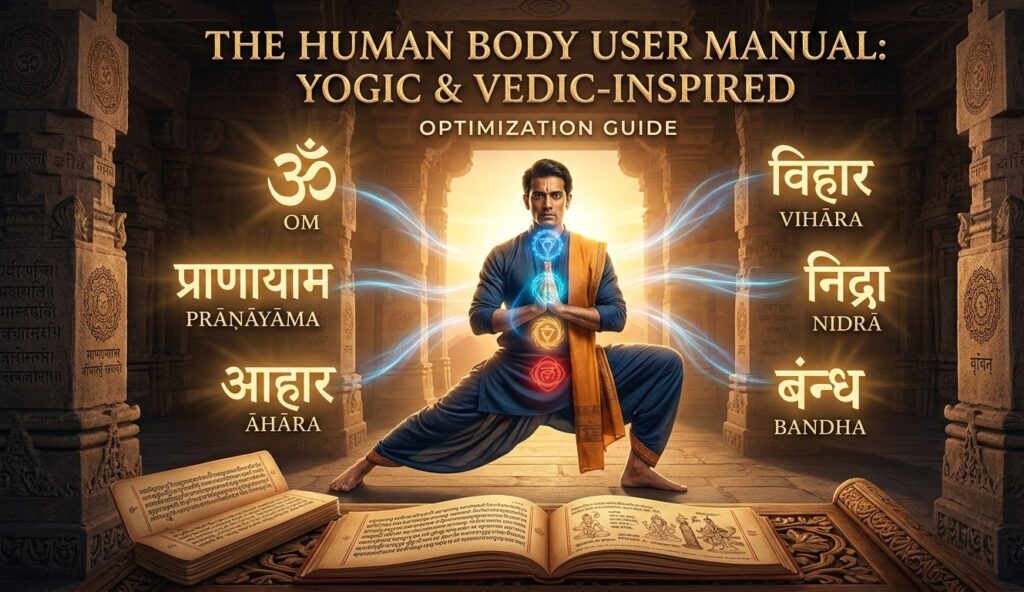
Model: Homo Sapiens | Operating System: Yogic & Vedic Protocols
Design Intent: The body (śarīra) is an instrument. When properly tuned, it remains stable, energetically balanced, and supportive of mental clarity. When neglected, it consumes your attention with friction and fatigue.
🌬️ Module 1: Master Lever (Prāṇa Management)
Breath is the primary control interface for the nervous system. Stabilizing your breathing directly stabilizes your attention and emotions.
Daily Maintenance (5–12 Minutes)
- Default Setting: Breathe through the nose during rest, work, and light movement.
- System Reset (2–3 mins): Inhale gently; make the exhale slightly longer than the inhale. Keep it smooth.
- Nadi Śodhana / Alternate Nostril (5 mins): Practice at a gentle pace on an empty stomach to balance the system.
Safety Rule: Never force breath retention. If you feel dizzy, return to default nasal breathing immediately.
🥗 Module 2: Fuel & Mind-Shaper (Mitāhāra)
Ayurveda places digestion (agni) at the center of systemic health. Food is not just fuel; it dictates the clarity of your consciousness.
The 3 Golden Operating Rules
- Stop at 80% Capacity: Leave room in the “tank” for digestion to occur.
- Keep Meals Simple: Fewer mixed items reduce the processing load on your gut.
- Consistent Timing: Eat at the same times daily to sync your biological clock.
Optimal Plate Composition Table
| Component | Percentage | Recommended Sources |
| Vegetables | 50% | Cooked seasonal produce |
| Protein | 25% | Dal, legumes, dairy, eggs, meat (if applicable) |
| Starches | 25% | Rice, roti, millet, potatoes |
| Fats | Add-on | Ghee, healthy oils, nuts (in moderation) |
🧘🏽♂️ Module 3: System Lubrication (Vihāra + Āsana)
Your hardware requires daily movement to prevent physical degradation. Yogic āsana is engineered for steadiness and ease, not ego-driven performance.
Minimum Daily Movement (20–30 Minutes)
- Option A: Brisk walk with nasal breathing.
- Option B: Simple Yoga sequence (Surya Namaskar, balance poses, hip openers).
Non-Negotiable Hardware Checks
- Spine Mobility: Flex, extend, and rotate the spine gently every day.
- Leg Strength: Perform squats, chair sits, or stair climbs to maintain foundational power.
🌙 Module 4: Built-in Repair Mode (Dinacharyā & Sleep)
Routine (Dinacharyā) acts as a health multiplier. Your body’s repair mechanisms rely heavily on rhythmic predictability.
The 4-Point Sleep Protocol
- Fixed Wake Time: The single most powerful lever for setting your circadian rhythm.
- Morning Light: Expose your eyes to outdoor light for 10–15 minutes upon waking.
- Stimulant Cutoff: Cease caffeine intake at least 8 hours before your target sleep time.
- Wind-Down Sequence: Dim screens 45 minutes prior. Spend 10 minutes stretching, breathing slowly, or practicing gratitude to close mental loops.
🔋 Module 5: Energy Preservation (Yama, Niyama & Śaucha)
Efficiency is achieved by plugging energy leaks. Reactivity, harsh inner talk, and impulsive consumption drain your battery faster than physical exertion.
- Ahimsa (Non-harm): Reduce self-sabotage, overtraining, and negative self-talk.
- Brahmacharya (Energy Management): Avoid compulsive stimulation like endless scrolling or late-night binge-watching.
- Śaucha (Hygiene): Maintain daily bathing, thorough oral hygiene (including tongue scraping), and a tidy immediate environment to promote mental clarity.
⏱️ Quick-Start: 20-Minute Daily Boot Sequence
If you are short on time, run this plug-and-play routine daily to keep the system online and optimized.
| Phase | Duration | Action |
| Morning | 2 mins | Quiet sitting with extended exhales. |
| Morning | 5 mins | Gentle Nadi Śodhana (Alternate Nostril Breathing). |
| Morning | 5 mins | Spine mobility + 15 squats (or Surya Namaskar). |
| Midday | 2 mins | Stand, stretch, or take a brief walk after lunch. |
| Evening | 6 mins | Light hip/spine stretching + slow breathing + set intent for tomorrow. |
🔧 Troubleshooting Guide
If the system experiences errors, consult this matrix before attempting major overhauls.
| System Symptom | Primary Adjustment | Secondary Adjustment |
| Constant Fatigue | Earlier bedtime + morning light exposure. | Reduce heavy, late-night dinners. |
| Restless / Anxious | 5 minutes of slow breathing (long exhales). | Reduce stimulants and screen scrolling. |
| Heavy / Sluggish | Simplify meals and reduce overall quantity. | Add a 20-minute daily brisk walk. |
| Inconsistent Focus | Enforce a strictly fixed wake time. | No phone usage for the first hour of the day. |
| Aches / Stiffness | Daily spine and hip mobility drills. | Gradually strengthen legs and core. |
⚠️ DEVELOPER WARNING: These advanced modules (Sādhanā) put higher stress on the system to trigger deeper adaptations. Do not run these protocols unless your base operating system (Modules 1–5: consistent sleep, stable digestion, and daily movement) is fully installed and running without errors.
⚙️ Module 6: Deep System Defragmentation (Upavāsa / Fasting)
Once the daily 80% capacity rule (Mitāhāra) is mastered, power users utilize fasting to trigger cellular cleanup (autophagy) and completely rest the digestive hardware.
Advanced Execution:
- Circadian Fasting: Align your eating window strictly with the sun (e.g., eat only between 9:00 AM and 6:00 PM).
- The Fortnightly Reboot (Ekādaśī principle): Once every 14 days, perform a 24-hour digestive rest. Consume only water, herbal teas, or very light, easily digestible liquids. This redirects the massive energy usually spent on digestion toward tissue repair and immune function.
🔋 Module 7: Energy Containment Locks (Bandhas)
Power users don’t just generate energy; they seal the leaks. Bandhas (physical locks) optimize intra-abdominal pressure and stimulate the vagus nerve.
Core Protocols (Practice only on an empty stomach):
- Root Lock (Mūla Bandha): A subtle lifting of the pelvic floor (similar to Kegel exercises but sustained and integrated with breath). Use this during heavy lifting or intense focus to stabilize the lower spine and nervous system.
- Abdominal Lock (Uḍḍīyāna Bandha): After a complete exhale, pulling the abdomen up and in under the ribcage. This acts as a manual massage for the digestive organs and a powerful reboot for the enteric nervous system. (Note: Best learned first from a qualified instructor).
🛌 Module 8: Rapid Battery Recharge (Yoga Nidrā)
Standard sleep is passive; Yoga Nidrā (often called Non-Sleep Deep Rest or NSDR) is conscious deep rest. It allows you to access deep restorative brainwave states (theta and delta) while remaining partially awake.
The 20-Minute Protocol:
- Lie flat on the floor in a quiet room with a light blanket.
- Listen to a guided Yoga Nidrā or NSDR audio track.
- Systematically rotate your attention through every body part without moving it.
- The ROI: A 20-to-30-minute session can provide the nervous system reset equivalent of a short, high-quality nap, wiping away afternoon brain fog and reducing cortisol without sleep inertia.
🔕 Module 9: Input/Output Port Management (Pratyāhāra & Mauna)
The modern brain is constantly processing sensory data, leading to cognitive fatigue. Advanced users intentionally throttle their sensory inputs to build mental bandwidth.
High-Level Controls:
- Tactical Silence (Mauna): Schedule 2 to 4 hours per week (e.g., Sunday morning) of absolute silence. No speaking, no texting, no media consumption. This rapidly rebuilds dopamine baseline and mental clarity.
- Visual Fasting: Switch your phone to grayscale mode. The visual cortex consumes massive energy processing bright colors; grayscale turns your device back into a simple tool rather than a slot machine.
🎯 Module 10: Overclocking Focus (Dhāraṇā)
To achieve flow states at will, you must train your attention span like a muscle. Scattered eyes equal a scattered mind.
The Ocular Stability Drill (Trāṭaka):
- Light a candle and place it at eye level, roughly two feet away (or use a black dot on a wall).
- Stare at the flame without blinking until your eyes water slightly.
- Close your eyes and hold the after-image in your mind’s eye for as long as possible.
- Why it works: Stabilizing the gaze physically arrests the micro-movements of the eyes, which directly quiets the default mode network (the wandering part) of the brain.
The Ultimate Success Formula: Regularity + Moderation + Breath Control + Clean Habits.
This section expands the manual into the subtle hardware and environmental interface. These modules focus on the “Bio-Ritual” and “Vibrational” layers of the system, ensuring the instrument is not just functional, but resonant with its environment.
🌊 Module 11: Hardware Purification (Shatkarma / Kriyā)
In Vedic traditions, internal “software” (the mind) cannot run smoothly if the “hardware” (physical tracts) is clogged with metabolic waste (mala). These techniques clear the sensory and respiratory ports.
The “Maintenance” Protocol:
- Jala Neti (Nasal Irrigation): Using a saline solution to rinse the nasal passages. This improves the sensitivity of the Nadi system (energy channels) and enhances the efficiency of Module 1 (Prāṇa management).
- Kapālabhāti (Frontal Brain Cleansing): Short, forceful exhales followed by passive inhales.
- The Function: It acts as a “de-dusting” mechanism for the respiratory system and oxygenates the prefrontal cortex for better decision-making.
☀️ Module 12: Solar Integration (Sandhyā Logic)
The body is a solar-powered instrument. Vedic science emphasizes Sandhyā—the transition periods (dawn, noon, sunset). Operating against these cycles creates “system friction.”
Advanced Timing Protocol:
- Brahma Muhūrta (The Creator’s Hour): Wake up 1 hour 36 minutes before sunrise. At this time, the atmosphere is highest in Sattva (purity). The system’s processing speed for learning and meditation is at its peak.
- The Noon Peak: Your digestive fire (Agni) is strongest when the sun is highest. Schedule your most complex “fuel intake” (Module 3) strictly between 12:00 PM and 1:30 PM.
- Sunset Transition: As light fades, the body shifts from active output to internal storage. Reduce all high-intensity cognitive tasks after sunset.
🌬️ Module 13: Sub-System Winds (Vāyu Optimization)
Beyond the breath, the Vedic manual identifies five “winds” (Vāyus) that govern specific biological functions. Optimization requires balancing these flows.
| The Vāyu | Function | How to Optimize |
| Samāna | Digestion & Assimilation | Sit in Vajrāsana (kneeling) for 5 mins after meals. |
| Vyāna | Circulation & Nerve Flow | Practice full-body stretching (Module 4) to ensure no “blockages.” |
| Apāna | Elimination & Grounding | Ensure regular bowel movements; use squatting posture for elimination. |
| Udāna | Speech, Growth & Thought | Practice “Jalandhara Bandha” (Chin Lock) or humming to clear the throat. |
| Prāṇa | Intake of Energy/Oxygen | Prioritize fresh air and “Sattvic” sensory inputs (nature, silence). |
🔊 Module 14: Vibrational Tuning (Mantra & Japa)
The human nervous system is sensitive to sound frequencies. Vedic scriptures treat the body as a “Vina” (stringed instrument) that needs periodic tuning through vocal resonance.
The Resonance Protocol:
- The “A-U-M” Scan:
- 1. A (Aaa): Resonate in the lower abdomen (activates the base).
- 2. U (Ooo): Resonate in the chest/heart (activates the core).
- 3. M (Mmm): Resonate in the head/brain (activates the crown).
- The Effect: This vibration acts as a mechanical massage for internal organs and “calibrates” the cellular frequency to reduce stress hormones.
🕸️ Module 15: Layered Architecture (Pañca Kośa Management)
Advanced users recognize that the “Body” is actually five nested layers (Kośas). A manual that only focuses on the physical layer is incomplete.
The Full-Stack Checklist:
- Annamaya Kośa (Food Body): Ensure proper nutrition and hygiene (Modules 2, 3, 11).
- Prāṇamaya Kośa (Energy Body): Ensure breath-flow and Vāyu balance (Modules 1, 13).
- Manomaya Kośa (Mind Body): Manage sensory inputs and Mauna (Modules 9, 10).
- Vijñānamaya Kośa (Wisdom Body): Engage in Svādhyāya (self-study) and discernment.
- Ānandamaya Kośa (Bliss Body): Access through deep stillness and meditation.
🛠️ Advanced Troubleshooting (Symptom → Vedic Fix)
- If feeling ungrounded/flighty: Focus on Apāna Vāyu (Module 13) and eat root vegetables (Earth element).
- If feeling mentally “hot” or angry: Practice Sheetali Prāṇāyāma (cooling breath) and avoid Rajasic/spicy foods.
- If feeling physically “heavy” or stuck: Perform Kapālabhāti (Module 11) and increase sunlight exposure.
The Advanced Formula:
Clean the hardware (Kriyā) + Sync with the Sun (Sandhyā) + Tune the vibration (Mantra) = Peak Instrument Efficiency.