Most large enterprises do not move from a monolith to microservices because they suddenly like modern architecture. They do it because the old system has become expensive to change.
That is usually the real trigger. Releases take too long. One small feature touches too many modules. A failure in one area affects unrelated functions. Teams wait on a central platform group for changes. Over time, the technology problem becomes an operating model problem.
This is where the Strangler Pattern becomes useful.
It gives organisations a way to replace a legacy system gradually, while the business keeps running. Instead of rebuilding everything in one programme and hoping it works, teams move one capability at a time behind a controlled entry point. The old system continues to serve what has not yet been migrated. The new services take over only where they are ready.
Done well, this is less about architectural fashion and more about risk management.
What the Strangler Pattern actually is
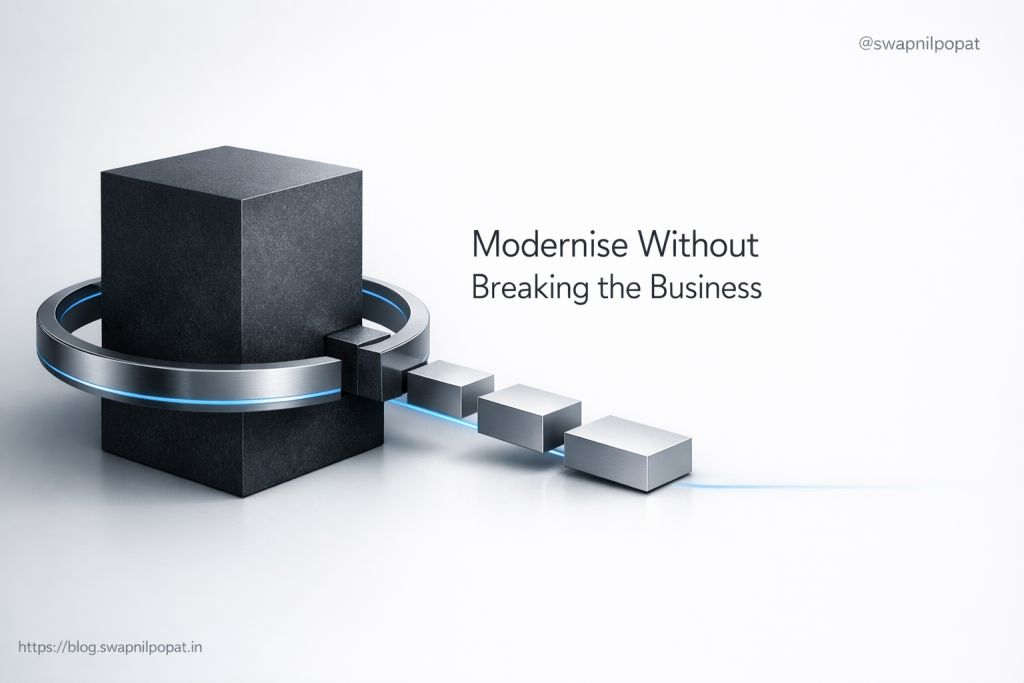
The name comes from the strangler fig, which grows around an existing tree and slowly replaces it. In software, the idea is similar: a new system is built around the old one and takes over piece by piece until the legacy application can be retired.
The usual mechanism is a gateway layer placed in front of the legacy estate. You will often hear this called a Strangler Facade.
This facade becomes the single entry point for client applications such as web apps, mobile apps, partner systems, or internal channels. At the beginning, it may do little more than proxy all requests to the legacy application. That is fine. Its value comes later, when it starts routing selected requests to newly built services.
So the pattern is not “rewrite the monolith”. It is “control traffic, then move capability in slices”.
That distinction matters because the traffic layer gives you options. Without that layer, migration becomes invasive very quickly. Every consumer must know which system to call. Coordination grows. Rollback gets harder. Testing becomes messy. The facade reduces that spread.
Why enterprises prefer this over a big-bang rewrite
A big-bang rewrite looks clean on a whiteboard. In practice, it often creates a long delivery gap between investment and visible outcome.
The business funds a large transformation. Teams spend months, sometimes years, rebuilding features they already had. During that period, the old system still needs support, defects still appear, and business teams still ask for change. The organisation ends up funding two worlds at once, with no easy cutover point.
The Strangler Pattern is attractive because it changes the economics of the move.
Instead of waiting for a complete replacement, the enterprise can target one domain, one journey, or one high-friction capability at a time. That means progress is visible earlier. Risk is easier to isolate. Teams learn what works before the migration becomes too large to steer.
For a brown-field enterprise, this is often the difference between a realistic modernisation plan and a transformation story that never quite lands.
The role of the Strangler Facade
At a technical level, the facade is commonly implemented through an API Gateway, reverse proxy, edge routing layer, or a combination of these. The exact product matters less than the responsibilities it takes on.
In a migration, the facade usually does four things.
1. It gives clients a stable entry point
Client applications continue to call one known endpoint, even while the backend is changing. This shields consumers from frequent changes in service boundaries during the migration.
That stability matters more than many teams expect. If every frontend, partner integration, or downstream system has to keep adapting during the transition, the migration spreads complexity instead of containing it.
2. It controls routing between old and new
Initially, almost all traffic may still go to the legacy application. As new services are introduced, the facade starts directing only the relevant calls to them.
For example, if the “User Profile” capability is migrated first, requests for profile read and update operations can go to the new service, while everything else still goes to the old stack.
This selective routing is the heart of the pattern.
3. It creates a rollback path
If a new service has a production issue, routing can be shifted back to the legacy implementation while the team fixes the problem.
This is one of the practical reasons the pattern works in large organisations. It reduces the blast radius of change. You are not choosing between “launch” and “disaster”. You usually have an intermediate option.
That said, rollback is only simple when data ownership is clear. If both systems are writing to the same business state in different ways, fallback becomes much harder. More on that later.
4. It helps standardise cross-cutting concerns
Authentication, rate limiting, request logging, observability hooks, and sometimes basic policy controls can be handled at the facade layer.
This is useful during migration because it prevents every new service from solving the same edge problems differently. But it should be handled with restraint. If the gateway becomes too smart, you can end up rebuilding a distributed monolith at the edge.
How the migration usually works in practice
The broad sequence is simple. The real work is in choosing the slices well.
Start by keeping the old system in place
A common mistake is to treat the legacy application as something that must be dismantled immediately. In reality, the old system is what keeps the business running while the migration takes shape.
So the first move is often not to rewrite code, but to introduce controlled access in front of it. This may mean putting an API Gateway, edge proxy, or facade in place and routing all traffic through it.
At this stage, the external behaviour may not change at all. That is acceptable. The goal is to gain control over request flow before splitting functionality.
Choose the first capability carefully
Not every feature is a good first candidate.
Teams often say, “Let us pick something small.” Small helps, but it is not enough. A good first slice is usually:
- narrow enough to build and release in a reasonable time
- useful enough to prove the migration model
- isolated enough to avoid deep dependency chains
- visible enough that the organisation learns from it
“User Profile” is a common teaching example because it is easy to explain. In reality, the right choice depends on coupling, data ownership, regulatory controls, and operational sensitivity.
For most teams, the first target should not be the most business-critical capability in the estate. Nor should it be something trivial that proves nothing. You want a slice that is representative, not reckless.
Build the new service around a clear boundary
Once a capability is chosen, a new service is built to own that function. This is where many migration efforts become harder than expected.
The technical part is not only writing a service. It is deciding what that service truly owns. If the boundary is weak, the new service still depends on the monolith for every significant action. That creates chatty calls, awkward data sharing, and release coupling.
A service should own a coherent business capability, not just expose a thin wrapper over old internals.
This is why domain thinking matters. If the team only copies old module boundaries into smaller deployments, they may get many services without gaining much independence.
Route selected traffic to the new service
After the new service is production-ready, the facade is updated so relevant requests go to it.
This routing can be based on endpoint, version, tenant, geography, or other controlled criteria. Some organisations start with internal users or a limited customer segment before moving all traffic over.
That gradual ramp-up is often more valuable than a full switch. It gives teams operational feedback under real conditions without exposing the whole customer base to early defects.
Repeat, but do not assume every slice is equal
Once one capability moves successfully, the process repeats. Over time, more traffic shifts away from the monolith, and the legacy application becomes smaller in scope and less central to operations.
But this stage is where many programmes lose discipline.
The early wins are usually the easier services. Later slices tend to involve more shared data, more business rules, and more entangled workflows. Progress can slow down. Governance questions become sharper. Integration complexity increases.
A sensible migration plan accounts for this. The middle and final stages are often harder than the beginning.
The real benefits, beyond the textbook version
The standard benefits are well known: less risk, no big-bang cutover, and the ability to modernise incrementally. Those are true, but they are a bit abstract on their own.
Here is what the pattern changes in operational terms.
It reduces migration risk to a series of smaller bets
Instead of placing one large architectural bet, the enterprise makes many smaller ones. Some slices will go smoothly. Some will reveal hidden coupling. Some may need to be redesigned.
That is healthy. You learn while moving, not only after a major release programme has consumed the budget.
It keeps the business available during change
For customer-facing systems, availability is non-negotiable. A migration approach that expects long service windows or broad outages is rarely acceptable.
The Strangler Pattern supports continuity because the old system remains active until replacements are ready. Customers do not need to know which backend serves which capability. From their point of view, the service remains available.
That said, “zero downtime” should not be claimed casually. It is achievable only if traffic switching, data consistency, release controls, and rollback paths are designed properly. The pattern makes low-disruption migration possible, but it does not guarantee it on its own.
It allows architecture and operating model to evolve together
This matters more than the technology itself.
A monolith often survives because the organisation around it is centralised. One team approves changes. Another team controls environments. Another manages releases. Moving to microservices without changing those behaviours simply creates slower distributed systems.
The Strangler Pattern gives teams time to evolve the operating model along with the architecture. Service ownership, monitoring responsibility, deployment autonomy, and support accountability can mature gradually rather than arriving all at once.
Where this pattern breaks down
The pattern is useful, but it is not magic. There are several ways teams get stuck.
Shared data is the hardest part
Routing requests is usually easier than separating data.
In many legacy estates, multiple modules read and write the same database tables. Business logic sits in stored procedures, batch jobs, and hidden integration points. A new service may look independent at the API layer while still depending heavily on shared persistence underneath.
This is where migrations become fragile.
If the new service and the monolith both update the same data without clear ownership rules, inconsistencies will appear. Rollback gets messy. Testing takes longer. Production support becomes political because no one is sure where the truth lives.
For that reason, one of the hardest and most important decisions is data ownership. If that is vague, the migration will remain half-decoupled.
The gateway can become a dumping ground
The facade is meant to control access and routing. It is not meant to become the new core application.
Teams under delivery pressure sometimes push too much business logic into the API Gateway because it feels convenient: a quick rule here, a transformation there, some orchestration, some customer-specific handling. Over time, the gateway becomes another central dependency.
That creates a familiar problem in a new form.
A good test is simple: if removing or replacing the gateway would require rebuilding core business behaviour, the layer is carrying too much responsibility.
Service boundaries can be drawn for convenience, not coherence
Some teams migrate based on old application modules or team charts rather than business capability. That often creates services that are too coupled to act independently.
The result is a distributed monolith: many deployables, but shared releases, heavy synchronous calls, and frequent cross-team coordination.
This tends to happen when the organisation focuses on decomposition before it understands the domain. Microservices amplify poor boundaries; they do not fix them.
Migration fatigue is real
The first phase of a strangler programme often gets attention and funding. The middle phase is harder. The final phase can become politically unglamorous.
By that point, the easiest capabilities have moved. What remains may be older, more entangled, and less visible to business stakeholders. If executive support fades, the organisation can get stuck with the cost of both the monolith and the microservices estate.
This is one reason legacy modernisation is a leadership issue, not just an engineering one.
The people side is not secondary
The draft is right to point out that this is not only a technology story.
In established enterprises, architecture follows incentives and operating habits. If those do not change, the migration will be slower and more frustrating than expected.
Executive sponsorship matters because the transition is uneven
A strangler migration does not produce clean, linear progress. Some quarters will show visible wins. Others will be spent untangling dependencies or fixing non-obvious platform issues.
Without senior backing, these pauses are often misread as failure. Funding gets questioned. Teams are asked why the old system still exists. Pressure builds for shortcuts.
Good executive support is not ceremonial. It means leadership understands that incremental replacement produces uneven but compounding gains.
Central teams need to change their role
Many enterprises have Centre of Excellence structures or strong central architecture groups. These teams often exist for valid reasons: control, consistency, compliance, and scarce expertise.
The problem appears when those groups continue to dominate every implementation decision in a microservices model.
A service-based architecture works better when teams can own build, deployment, observability, and support for the services they create. Central teams still matter, but their role shifts from command-and-control to enablement, guardrails, platform support, and standards.
That transition is rarely comfortable. It changes status, ownership, and decision rights.
Teams need operational maturity, not only coding skill
Building a service is one step. Running it well is another.
Teams need to understand versioning, monitoring, alerting, failure handling, dependency management, capacity planning, and on-call responsibility. If they are used to handing those concerns to a separate operations or middleware team, microservices can expose capability gaps quickly.
In practice, this is why continuous learning matters. The migration succeeds when teams become accountable for the full lifecycle of what they build.
A practical way to think about sequencing
There is no universal migration order, but a few principles tend to help.
Start where change friction is high
If one area of the monolith changes frequently and slows every release, that is often a strong candidate. Migrating that capability can reduce delivery pain early.
Avoid the most entangled core first
The core order-processing engine or central billing flow may be strategically important, but it may also be deeply tied to everything else. Starting there can stall the programme.
Use business capability, not technical layer, as the unit of migration
Moving “all APIs” or “all frontend code” first often sounds neat but does not reduce business coupling. Capability-based slices usually produce clearer ownership.
Plan for coexistence, not instant purity
For a while, the old and new worlds will coexist. Monitoring, data sync, support ownership, and incident processes need to account for that mixed state. Teams that pretend the transition state is temporary and therefore unimportant usually create operational pain.
When the Strangler Pattern is a good fit
This approach is usually a good fit when:
- the existing system is too critical to replace in one cutover
- the legacy application still works but is hard to change
- the organisation needs gradual progress rather than a multi-year all-or-nothing rewrite
- there is enough control over traffic flow to introduce a facade or gateway
- teams can define meaningful service boundaries over time
It is less suitable when the system is so unstable that keeping it in place is itself a major risk, or when the organisation lacks the ability to operate a hybrid architecture for a sustained period.
What decision-makers should take away
The Strangler Pattern is not a shortcut to microservices. It is a disciplined way to manage change in a live business.
Its strength is not that it makes migration easy. It makes migration survivable.
For engineering leaders, the key question is not “How quickly can we break the monolith?” It is “How do we reduce dependency, shift ownership, and retire risk without disrupting the business?”
For business leaders, the more useful framing is this: a legacy modernisation effort succeeds when it improves speed of change, lowers operational fragility, and gives teams clearer ownership. If the programme only produces more services and more complexity, it has missed the point.
How AI is changing this migration approach
AI is already affecting strangler migrations, but not in the simplistic sense of “AI will modernise legacy systems for you”. What it is doing is changing the speed, visibility, and discipline of the work.
First, AI is improving legacy system understanding. One of the hardest parts of a strangler programme is figuring out what the old system actually does, where business rules sit, and which components are more coupled than they appear. AI tools can help teams inspect codebases, trace dependencies, summarise modules, and surface candidate service boundaries faster than manual reading alone. That does not remove the need for experienced architects, but it can reduce the time spent on basic discovery.
Second, AI is making migration execution more productive, though not less risky. Teams are using AI assistants to draft service scaffolding, write test cases, generate adapters, document APIs, and suggest refactoring paths. This is useful in the repetitive parts of the move. The trade-off is that generated code can make a weak design look finished. If the service boundary is wrong, AI will help you implement the wrong thing faster.
Third, AI is strengthening observability and operational support during coexistence. In strangler migrations, the difficult period is when old and new systems are both live. AI-based monitoring and analysis tools can help detect traffic anomalies, compare legacy and new-service behaviour, flag regressions, and speed up root-cause analysis. That is valuable because migration failures often come from mismatches in edge cases rather than obvious outages.
There is also a broader strategic effect. As AI increases delivery speed, the cost of being trapped in a monolith becomes more visible. If product teams can prototype, test, and ship faster, but the underlying architecture still forces central approvals and tightly coupled releases, the organisation feels that constraint more sharply. In that sense, AI is not replacing the Strangler Pattern. It is increasing the pressure to modernise in a way the business can sustain.
The sensible view is this: AI is a force multiplier, not a migration strategy. It can help teams understand legacy estates, move faster on implementation, and manage hybrid operations with better signal. But the hard parts remain human: choosing service boundaries, deciding data ownership, handling organisational resistance, and knowing when a partial migration is creating more complexity than value.
Conclusion
The Strangler Pattern works because it respects a reality many transformation plans ignore: old systems cannot simply disappear on command.
They have customers, dependencies, embedded processes, and institutional history. Replacing them safely requires control, patience, and better boundaries than the original system had.
Putting a facade in front of the legacy estate is only the beginning. The harder work is choosing the right slices, handling data ownership, building teams that can run what they ship, and sustaining leadership support through the uneven middle of the migration.
For brown-field enterprises, that is often the most credible route from legacy software to microservices: not one dramatic rewrite, but a series of well-managed replacements that steadily move control away from the old system until retiring it becomes an operational decision rather than a leap of faith.