
The Architecture Crisis in IoT: Why Your ThingWorx Implementation Success Depends on Getting This Right
The Sobering Reality: According to Cisco’s IoT study, 75% of IoT projects fail, and Microsoft’s research reveals that 30% of these failures stem from poor architectural decisions made early in the project lifecycle. In the ThingWorx ecosystem, this translates to millions of dollars in wasted investment and months of delayed time-to-market.
The ThingWorx Architecture Dilemma: You’re tasked with building a robust IoT solution using ThingWorx 9.6.1. Your requirements seem straightforward: collect data from multiple sources, process it intelligently, and present actionable insights. Yet beneath this simplicity lies a complex architectural challenge that will determine whether your solution scales gracefully or collapses under real-world pressure.
Why Architecture Matters More Than Ever: In today’s hyper-connected industrial landscape, your ThingWorx implementation isn’t just handling sensor data—it’s becoming the nervous system of your entire operation. A poorly architected system doesn’t just slow down; it becomes a single point of failure that can cascade through your entire business process.
The Cost of Getting It Wrong:
- Performance Degradation: Monolithic architectures that worked fine in development can grind to a halt when faced with production data volumes
- Scaling Nightmares: Adding new data sources or users becomes exponentially more complex and expensive
- Maintenance Burden: Technical debt accumulates rapidly, making even simple changes risky and time-consuming
- Integration Challenges: Connecting to new systems becomes a major project rather than a routine task
1.1. Overview:
Brief Introduction: Thingworx solution is used to collect and consolidate data from various external systems, store selected information (e.g., IDs, references) in its own database, and generate new data based on the aggregated inputs. Additionally, the middleware will expose an interface to: Additionally, Thingworx will expose an interface to:
- Retrieve data from external systems and stored in its internal database,
- Present data using mashups,
- Allow users trace objects from multiple external systems.
By centralizing the data retrieval and transformation process, Thingworx aims to simplify and standardize how different external sources are linked, reduce duplication of data across systems, and provide a unified interface for all system-to-system and user-driven interactions.
Decision Criteria:
When deciding on the architecture for Thingworx, it is crucial to consider several key factors. Below is a summary of the decision criteria that will guide the selection of the most appropriate architectural style(s):
- Integration Complexity
- Scalability and Performance
- State Management
- Data Consistency and Reliability
- Extensibility and Maintainability
- Operational Complexity
- Security and Compliance
- Time-to-Market vs. Long-Term Strategy
1.2. Architectual Suggestions (AS):
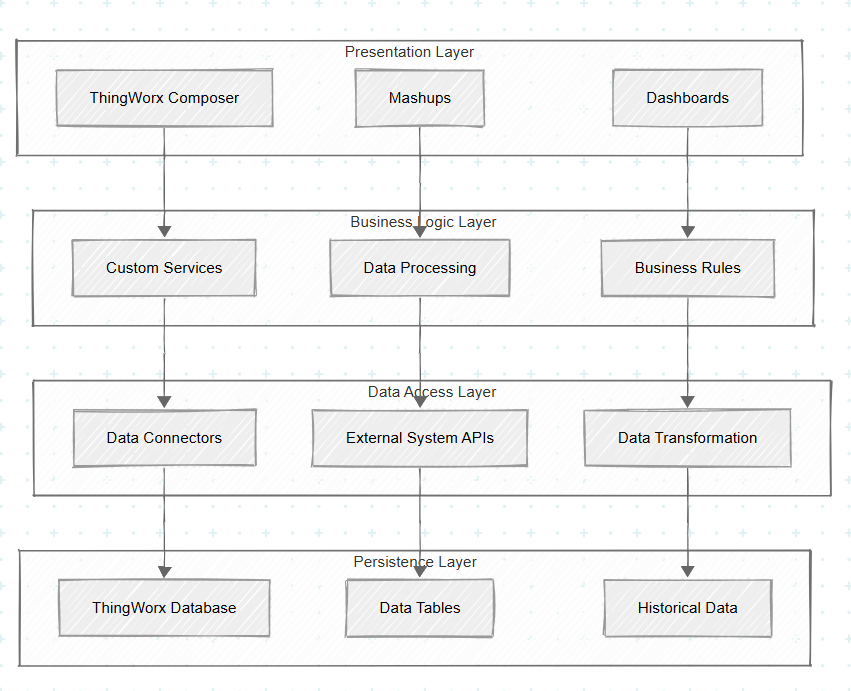
Suggestion 01: Layered Architecture
| Description | Pros | Cons | Notes |
|---|---|---|---|
| Traditional N-tier approach with presentation (ThingWorx Composer), business logic (custom services), data access (data connectors), and persistence layers (ThingWorx database). —————————- Think of this like a multi-story office building where each floor has a specific purpose. In ThingWorx, this means organizing your system into distinct layers: the top floor (presentation layer) shows dashboards and reports, the middle floor (business logic) processes data and rules, and the bottom floor (data layer) stores information. Each layer only talks to the layer directly above or below it, just like how office workers typically interact with people on adjacent floors. | • Clear separation of concerns • Easy to understand and maintain • Leverages ThingWorx’s built-in structure • Good for team organization ————————— • Easy to understand: Like a well-organized office building, everyone knows where to find what they need • Easy to maintain: Problems in one layer don’t affect others, like fixing plumbing on one floor doesn’t disrupt other floors • Team efficiency: Different teams can work on different layers simultaneously • Built-in structure: ThingWorx naturally supports this organization | • Can become monolithic • Potential performance bottlenecks • Limited horizontal scaling • Tight coupling between layers —————————-• Can become rigid: Like a strict office hierarchy, changes can be slow to implement. • Performance bottlenecks: All requests must go through each layer, like having to stop at every floor in an elevator. • Scaling limitations: Hard to expand just one part of the system • Dependency issues: If one layer fails, it can affect the entire system. | Well-suited for ThingWorx’s native architecture. Consider for moderate complexity solutions with clear functional boundaries. —————————-Best for: Traditional business applications where clear organization is more important than flexibility. Good for teams new to ThingWorx who need a structured approach. |
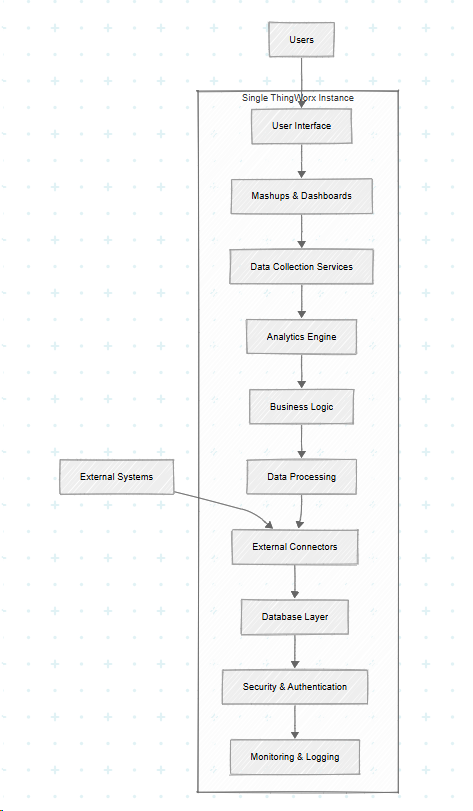
Suggestion 02:Monolithic Architecture
| Description | Pros | Cons | Notes |
|---|---|---|---|
| Single deployable ThingWorx instance containing all entities, services, mashups, and data processing logic in one unified platform deployment. ————————– Think of this like a large department store where everything you need is under one roof. Your ThingWorx system is a single, unified application containing all features – data collection, processing, dashboards, and user management – all deployed together as one package. Like how a department store has clothes, electronics, and groceries all in one building, your IoT solution has all components in one ThingWorx instance. | • Simple deployment and testing • Easier debugging and monitoring • Leverages ThingWorx’s unified platform • Lower operational overhead • Faster development cycle ————————— • Simplicity: Like shopping at one store instead of visiting multiple locations • Easy testing: You can test everything together, like a store manager overseeing all departments • Faster development: No need to coordinate between different systems • Cost-effective: Lower operational costs, like maintaining one building instead of multiple locations • Unified monitoring: One system to monitor and troubleshoot | • Difficult to scale specific components • Technology lock-in to ThingWorx • Large codebase complexity • Single point of failure • Resource contention. —————————- • Hard to scale parts: You can’t expand just the electronics section without affecting the whole store • Technology limitations: Stuck with one technology stack, like a store that can only sell certain brands • Single point of failure: If the store closes, everything stops • Team conflicts: Multiple teams working on the same codebase can interfere with each other • Deployment risks: Updating one feature requires redeploying everything | Recommended for smaller to medium-sized implementations. ThingWorx 9.6.1’s enhanced performance makes this viable for many use cases. ————————— Best for: Small to medium-sized IoT projects with limited complexity. Perfect when you have a small team and want to get up and running quickly with ThingWorx 9.6.1. |
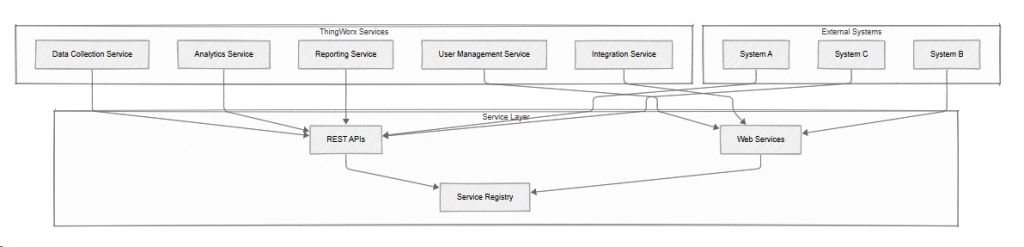
Suggestion 03:SOA(Service-Oriented Architecture)
| Description | Pros | Cons | Notes |
|---|---|---|---|
| Modular services exposed through ThingWorx REST APIs and web services, with external systems as service consumers/providers using standardized interfaces. ———————-Think of this like a business district where each building provides a specific service (bank, restaurant, post office). In ThingWorx, different services handle specific functions – one service for data collection, another for analytics, another for user management. These services communicate through well-defined interfaces (like standardized business protocols), and external systems can easily access these services through ThingWorx’s REST APIs. | • Reusable components• Platform independence• Supports ThingWorx’s REST API capabilities• Good for enterprise integration• Service contracts provide clarity. ——————- Reusability: Like how multiple businesses can use the same bank, services can be shared across different applications• Flexibility: Easy to replace one service without affecting others, like changing restaurants without affecting the bank• Integration-friendly: External systems can easily connect, like new businesses joining the district• ThingWorx strength: Platform provides excellent REST API support for service exposure | • Network latency overhead• Service discovery complexity• Versioning challenges• Performance overhead• Additional infrastructure complexity ——————— • Network overhead: Services need to communicate over the network, like traveling between buildings takes time• Complexity: Managing multiple services is like coordinating multiple businesses• Version management: Updating one service might affect others, like a bank changing its procedures affects all customers• Performance impact: Network calls between services can slow things down | ThingWorx 9.6.1 provides robust REST API support. Good for enterprise environments requiring system integration. ——————- Best for: Enterprise environments where you need to integrate ThingWorx with multiple existing systems. Good when different departments need to access your IoT data independently. |
Suggestion 04:Microservices Architecture
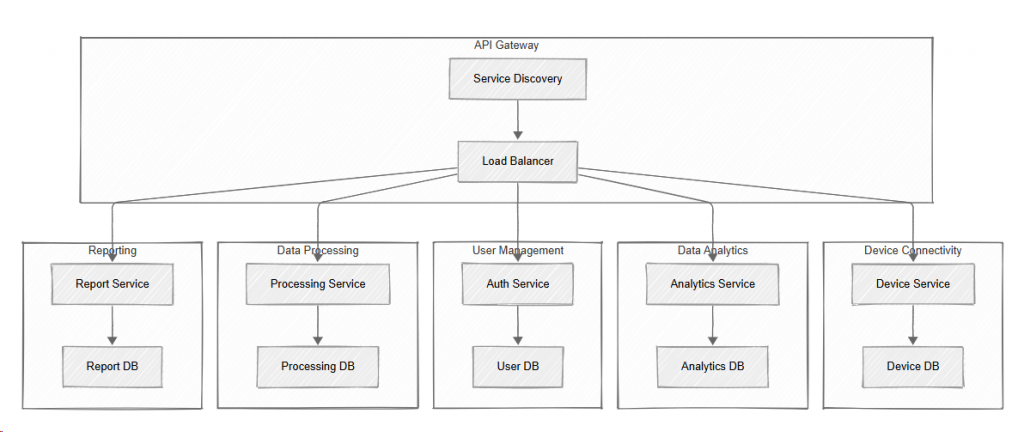
| Decomposed into small, independent services using ThingWorx Edge SDK, multiple ThingWorx instances, or external microservices communicating via APIs. ———— Think of this like a food court where each vendor specializes in one type of food and operates independently. In ThingWorx, you break your application into tiny, independent services – each with its own database and deployment cycle. One microservice might handle device connectivity, another handles data analytics, and another manages user authentication. Each can be developed, deployed, and scaled independently, possibly using ThingWorx Edge SDK for distributed components. | • Independent scaling and deployment• Technology diversity• Fault isolation• Team autonomy• Faster feature delivery —————–• Independent scaling: Popular food stalls can expand without affecting others• Team autonomy: Each team can work independently, like restaurant owners making their own decisions• Technology diversity: Different services can use different technologies, like vendors having different cooking methods• Fault isolation: If one service fails, others continue working.• Faster delivery: Small teams can develop and deploy features quickly | • Increased operational complexity• Network communication overhead• Data consistency challenges• Distributed system complexity• DevOps overhead ——————• Operational complexity: Managing a food court is harder than managing one restaurant• Network communication: Services must communicate over the network, creating potential delays• Data consistency: Ensuring all services have consistent data is challenging• Debugging difficulty: Tracing problems across multiple services is complex• Infrastructure overhead: Need sophisticated deployment and monitoring tools | Consider with ThingWorx Edge SDK for distributed deployments. Requires strong DevOps capabilities and container orchestration. ———————-Best for: Large, complex IoT systems with multiple teams. Requires strong technical expertise and DevOps capabilities. Consider when you have different parts of your system that need to scale independently. |
Suggestion 05:Reactive Architecture
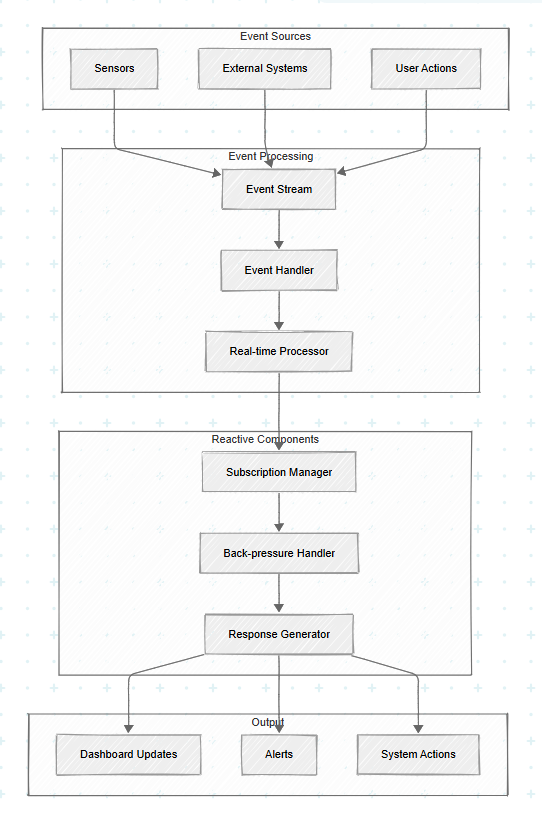
| Event-driven, responsive system using ThingWorx’s subscription mechanisms, event processing, and real-time data streams for immediate response to system changes. ——————- Think of this like a modern smart home that immediately responds to changes – lights adjust when you enter a room, temperature changes based on occupancy, and security systems react to motion. In ThingWorx, your system continuously monitors for events and responds immediately. When a sensor reading changes, the system instantly triggers appropriate actions, updates dashboards, and notifies relevant users without delay. | • High responsiveness• Efficient resource utilization• Leverages ThingWorx’s event system• Excellent for real-time IoT scenarios• Backpressure handling ——————–• Immediate response: Like a smart home that reacts instantly to your presence• Efficient resource use: Only uses resources when needed, like lights that turn on only when required• Perfect for IoT: Ideal for real-time monitoring and control systems• ThingWorx advantage: Platform’s event system is designed for reactive patterns• Scalable: Can handle many simultaneous events efficiently | • Complex debugging• Learning curve• Event ordering challenges• Potential memory leaks• Difficult to test ——————–• Complex debugging: Like troubleshooting a smart home, finding problems in reactive systems can be difficult• Learning curve: Requires understanding of reactive programming concepts• Event management: Ensuring events are processed in the right order can be challenging• Memory issues: Poor implementation can lead to memory leaks• Testing complexity: Difficult to test all possible event scenarios | Excellent fit for ThingWorx’s event-driven nature and real-time capabilities. Ideal for IoT data processing requirements. ———————-Best for: Real-time IoT monitoring systems, industrial automation, and any scenario where immediate response to changing conditions is critical. Excellent match for ThingWorx’s event-driven capabilities. |
Suggestion 06:Event-Driven
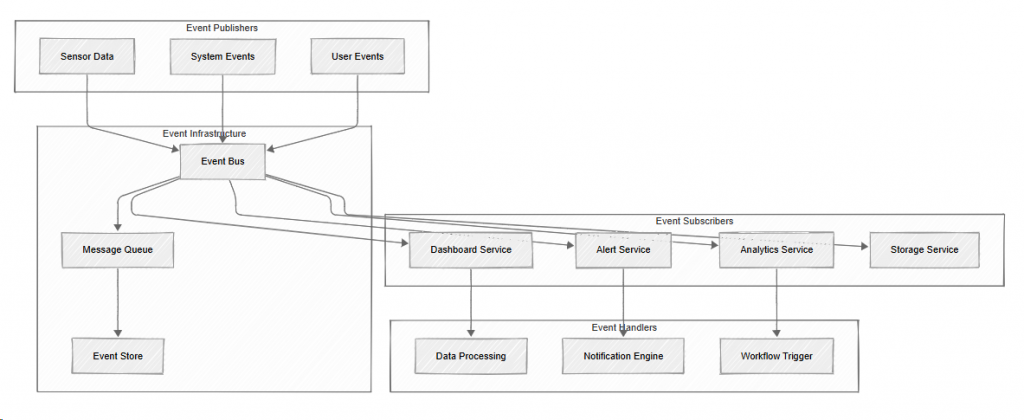
| Asynchronous communication using ThingWorx’s built-in event system, subscriptions, and message queues for loose coupling between system components. ——————– Think of this like a news broadcasting system where reporters (sensors/devices) send news (events) to a central newsroom (ThingWorx), which then broadcasts relevant updates to subscribers (dashboards, alerts, other systems). Components don’t directly communicate; instead, they publish events and subscribe to events they care about. When a temperature sensor detects a change, it publishes an event that multiple systems can react to independently. | • Loose coupling• High scalability• Natural fit for ThingWorx events• Real-time processing• Resilient to failures —————– • Loose coupling: Like how radio stations and listeners don’t need to know each other personally• Scalability: Easy to add new subscribers, like adding more radio listeners• Real-time processing: Events are processed as they happen• Natural fit: Perfect match for ThingWorx’s built-in event system• Flexibility: Easy to add new event handlers without changing existing code | • Event ordering complexity• Debugging challenges• Potential data loss• Event schema evolution• Eventual consistency ———————-• Event complexity: Managing the flow of events can become complex, like coordinating multiple news channels• Debugging challenges: Tracing event flows is like following a story across multiple news sources• Potential data loss: If the system is busy, some events might be missed• Order dependency: Some events must be processed in specific order• Schema evolution: Changing event formats can break existing subscribers | Strongly recommended for ThingWorx 9.6.1’s enhanced event handling capabilities. Perfect for data consolidation from multiple sources. ———————-Best for: IoT systems with multiple data sources and destinations. Perfect for ThingWorx 9.6.1’s enhanced event handling. Ideal when you need to consolidate data from many sources and distribute it to multiple consumers. |
Suggestion 07:CQRS(Command Query Responsibility Segregation)
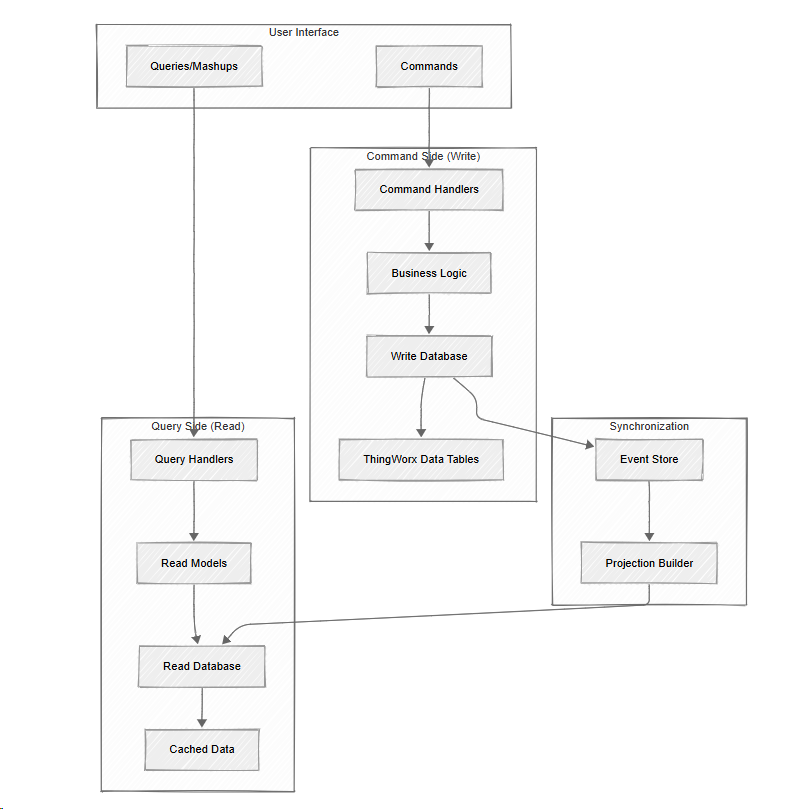
| Separate read and write models using ThingWorx’s data tables for writes and external read-optimized databases or caching for queries and mashup data. ——————-Think of this like a library system where there are separate processes for checking out books (commands/writes) and searching for books (queries/reads). The checkout desk handles all book lending and returning, while the search catalog is optimized for finding books quickly. In ThingWorx, you separate operations that change data (like updating sensor values) from operations that read data (like generating reports or displaying dashboards). | • Optimized read/write performance• Independent scaling• Flexibility in data modeling• Supports complex queries• Better mashup performance——————-• Optimized performance: Like having express lanes for different types of library users• Independent scaling: Can scale reading and writing operations separately• Flexible data models: Can optimize data storage differently for reads vs writes• Better analytics: Read-optimized databases can handle complex queries more efficiently• Improved mashup performance: Dashboards load faster with optimized read models | • Increased complexity• Data synchronization challenges• Eventual consistency• Additional infrastructure• Development overhead ———————————–• Increased complexity: Like managing two different library systems instead of one• Data synchronization: Ensuring read and write databases stay consistent• Eventual consistency: Updates might not be immediately visible in read models• Additional infrastructure: Need more systems and databases to manage• Development overhead: More complex to develop and maintain | Consider for high-volume data scenarios. Addresses ThingWorx data table limitations for complex queries.—————————–Best for: High-volume IoT systems where you have heavy data ingestion and complex reporting requirements. Consider when ThingWorx’s built-in data tables become a bottleneck for complex analytics. |
Suggestion 08:FaaS(Function as a Service)
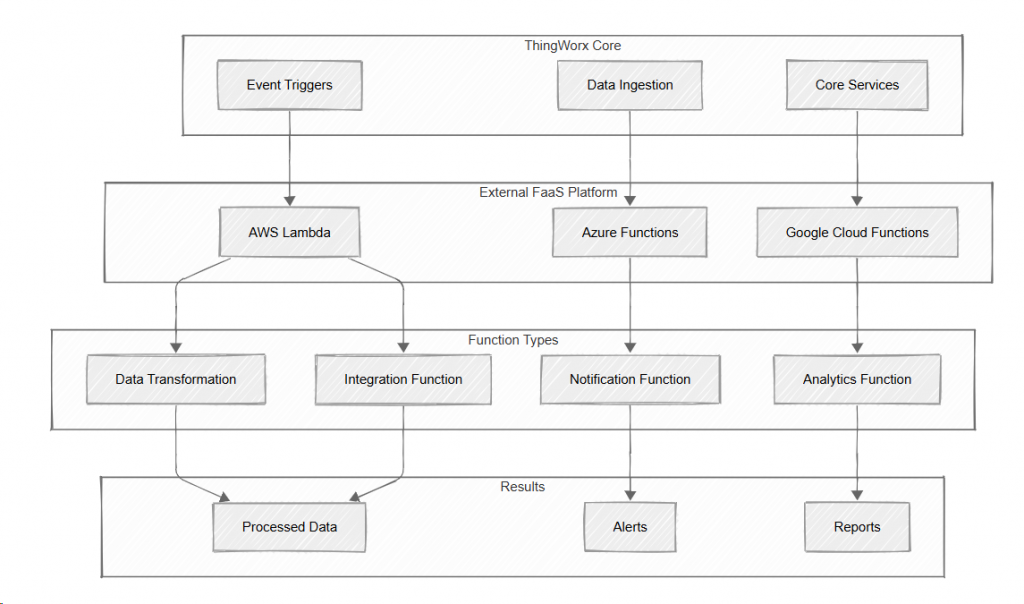
| Serverless functions for specific operations, potentially using external FaaS platforms (AWS Lambda, Azure Functions) integrated with ThingWorx services. ——–Think of this like calling specialized contractors only when you need them – you don’t hire a plumber full-time, you call one when you have a plumbing problem. In ThingWorx, instead of running services continuously, you create small functions that run only when triggered by specific events. For example, a data transformation function might run only when new sensor data arrives, or a notification function might execute only when an alert condition is met. | • Cost-effective• Automatic scaling• Pay-per-use model• No server management———• Cost-effective: Like paying contractors only when you use them• Automatic scaling: The cloud provider handles scaling, like a contractor service managing multiple jobs• No server management: No need to maintain infrastructure, like not worrying about contractor tools and equipment• Event-driven execution: Functions run automatically when triggered• Pay-per-use: Only pay for actual function execution time | • Limited ThingWorx integration• Cold start latency• Event-driven execution• Debugging difficulties ———————-• Cold start delays: Like waiting for a contractor to arrive and set up• Vendor dependency: Tied to specific cloud providers• Time limitations: Functions can’t run indefinitely• Debugging difficulty: Hard to troubleshoot problems in the cloud• Limited ThingWorx integration: Not natively supported in ThingWorx platform | Limited native support in ThingWorx. Consider for specific computational tasks or external data processing. —————————Best for: Specific computational tasks that don’t require continuous operation. Good for data processing, transformations, or integrations that happen infrequently. Limited applicability in core ThingWorx applications. |
Suggestion 09:Actor Model
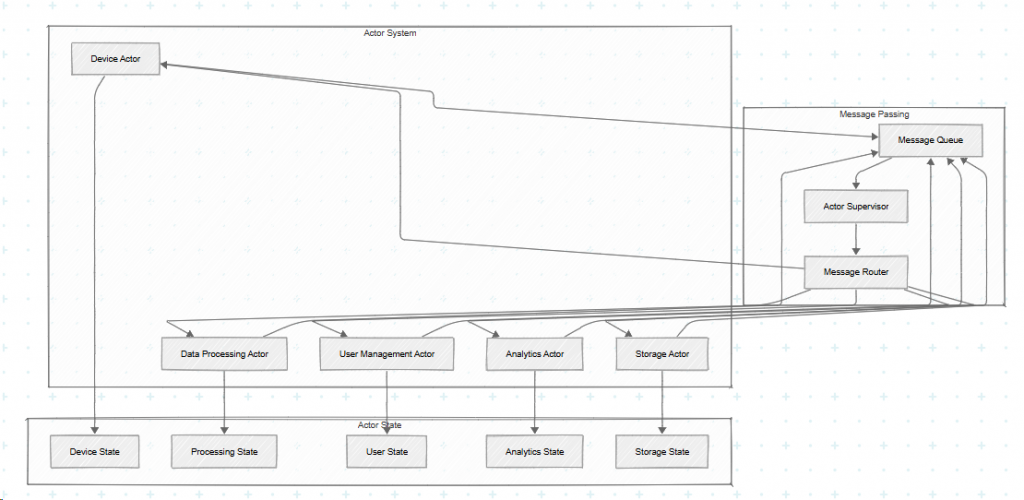
| Description | Pros | Cons | Notes |
|---|---|---|---|
| Concurrent computation using isolated actors, potentially implemented through ThingWorx’s Thing instances as actors handling specific business entities. ——————Think of this like a company with independent departments where each department (actor) has its own manager and handles specific responsibilities. Departments communicate only through formal messages (like emails or memos), never by directly accessing each other’s files or resources. In ThingWorx, you could implement this by having different “Things” act as independent actors, each managing their own state and responding to messages from other Things. | • Excellent concurrency handling• Message-based communication• Natural scalability• Encapsulation of state —————-• Fault tolerance: Like how one department’s problems don’t crash the entire company• Excellent concurrency: Multiple departments can work simultaneously without interfering• Message-based communication: Clear communication protocols, like formal business correspondence• Natural scalability: Easy to add new departments/actors as needed• Encapsulation: Each actor manages its own data and state securely | • Complex programming model• Debugging challenges• Memory management concerns• Not natively supported• Learning curve —————-• Complex programming: Like managing a large corporation, requires sophisticated coordination• Debugging challenges: Tracing problems across multiple actors is like investigating issues across departments• Memory management: Each actor needs its own resources• Not natively supported: ThingWorx doesn’t directly support the actor model• Learning curve: Requires understanding of concurrent programming concepts | Not directly supported in ThingWorx. Consider custom implementation with Things as actors for complex concurrent scenarios. ————————-Best for: Complex systems with many independent components that need to work concurrently. Would require custom implementation in ThingWorx. Consider only for very complex scenarios with experienced development teams. |
1.3 Comparison Table
| Architecture Pattern | Complexity | Scalability | Performance | Maintenance | ThingWorx Fit | Best For | Avoid When |
|---|---|---|---|---|---|---|---|
| Layered Architecture | Low | Medium | Medium | High | Excellent | Small-medium projects, structured teams | High-performance real-time systems |
| Monolithic Architecture | Low | Low | High | Medium | Excellent | Small projects, rapid prototyping | Large teams, complex requirements |
| SOA (Service-Oriented) | Medium | High | Medium | Medium | Good | Enterprise integration, existing systems | Simple applications, tight latency requirements |
| Microservices | Very High | Excellent | Variable | Low | Medium | Large teams, complex domains | Small projects, limited DevOps capability |
| Reactive Architecture | High | Excellent | Excellent | Medium | Excellent | Real-time systems, high-throughput | Simple CRUD applications |
| Event-Driven | Medium | Excellent | High | Medium | Excellent | Data consolidation, real-time processing | Synchronous processing requirements |
| CQRS | High | Excellent | Excellent | Low | Good | High-volume reads/writes, complex queries | Simple applications, limited data volume |
| FaaS (Function as a Service) | Medium | Excellent | Variable | High | Poor | Sporadic processing, cost optimization | Continuous processing, core business logic |
| Actor Model | Very High | Excellent | High | Low | Poor | Complex concurrent systems | Simple applications, traditional teams |
1.4 Decision Tree
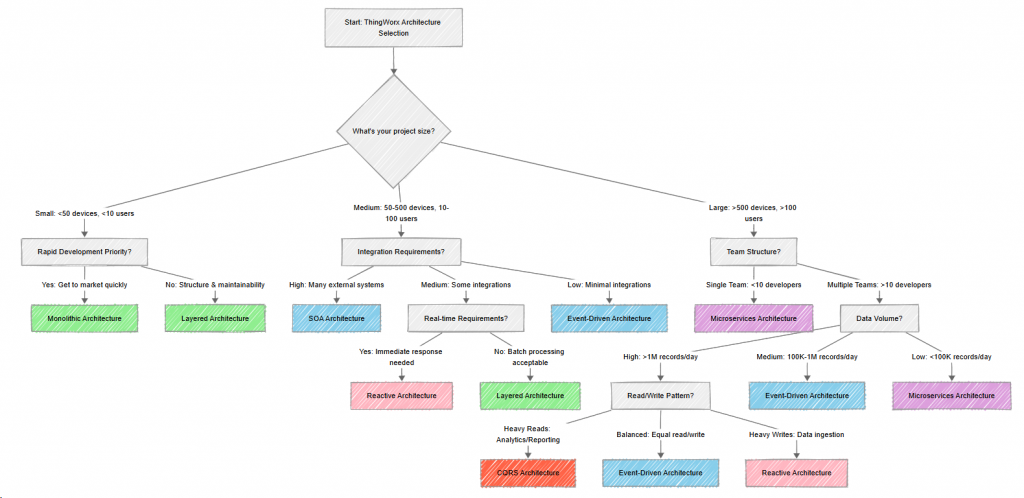
Decision Tree Usage Guide:
🟢 Green (Simple): Low complexity, quick implementation 🔵 Blue (Moderate): Medium complexity, balanced approach
🟣 Purple (Advanced): High complexity, sophisticated solutions 🔴 Red (Expert): Very high complexity, specialist knowledge required 🌸 Pink (Specialized): High-performance, specific use cases