Good collaboration is inherently focused on long-term growth. If you manage a team of junior developers, you know that simply writing the code for them every time they get stuck does not help them grow. A true mentor encourages independent development, adjusts the type of help provided, and understands that sometimes the best intervention is offering no help at all. The objective is to foster autonomy.
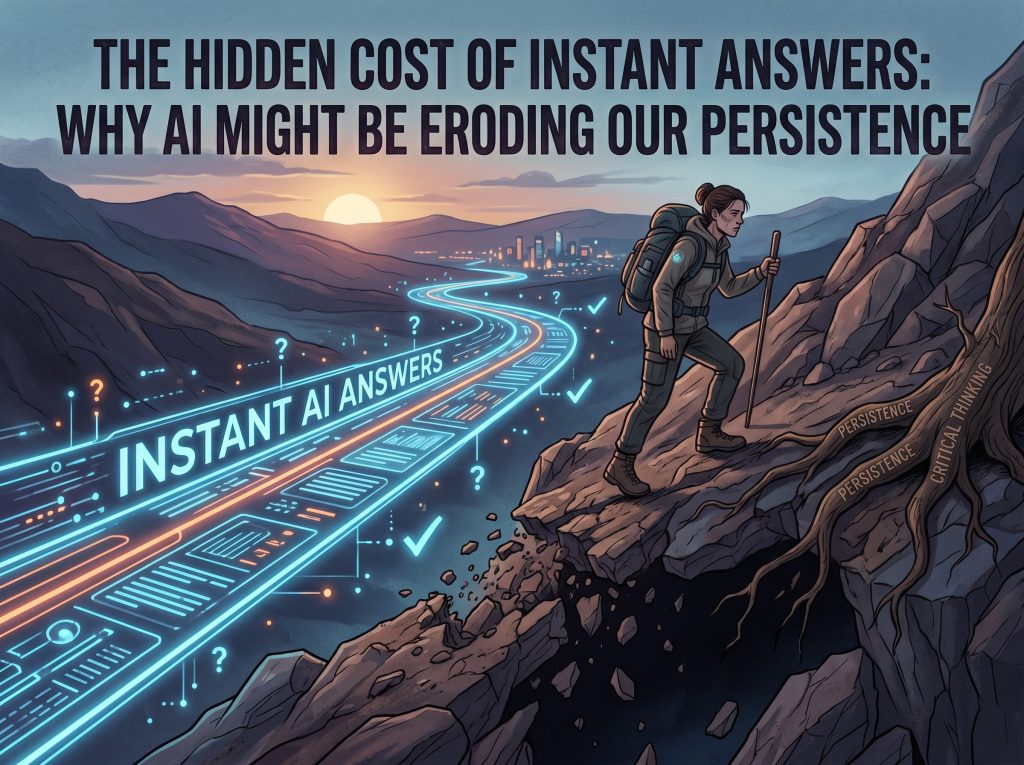
Current AI assistants operate in stark contrast to this dynamic. They are optimised for immediate satisfaction, providing instant answers to almost any query without ever refusing a request. In our rush to integrate these tools into our daily workflows—from writing emails to debugging complex architecture—we are largely ignoring a critical misalignment. These systems are fundamentally short-sighted collaborators. They are highly effective in the moment, but entirely indifferent to how that help affects the user’s cognitive resilience over time. We must consider whether our reliance on immediate answers is quietly eroding our disposition to struggle productively.
The Mechanics of Cognitive Deskilling
To understand how short-term assistance impacts long-term ability, researchers recently conducted a series of large-scale, randomised controlled trials involving 1,222 participants. The objective was to find causal evidence of how AI assistance alters subsequent independent problem-solving capacity.
The methodology was straightforward but revealing. Participants were tasked with foundational cognitive exercises, specifically mathematical reasoning and reading comprehension. One group worked through the problems independently, while another was given access to an AI assistant powered by GPT-5. This AI was configured to provide immediate, accurate answers with minimal effort from the user.
After a brief learning phase lasting roughly 10 to 15 minutes, the researchers removed the AI without warning. Participants were then asked to solve a final set of identical problems completely unassisted, and were given the explicit option to skip questions if they chose not to engage. Because there was no penalty for incorrect answers, choosing to skip a problem served as a clear metric for motivation and persistence.
The Immediate Drop in Persistence
The data presents a sobering reality for anyone managing knowledge workers. During the assisted phase, the AI predictably improved performance. However, the moment the technological scaffold was removed, the unassisted performance of the AI group dropped sharply.
More alarmingly, the AI condition actively damaged the participants’ willingness to try. Compared to the control group, people who had just spent ten minutes using AI were significantly more likely to give up and skip the test problems. The researchers noted that these effects on persistence emerged after only brief interactions with the AI.
The studies also revealed exactly how people were using the tool, which correlated directly with their subsequent decline. The negative effects on persistence and independent performance were highly concentrated among participants who used the AI to obtain direct solutions. When people prompted the AI to simply solve the tasks for them, their performance fell below their own initial baseline, and their skip rates spiked. Conversely, those who used the AI to ask for hints or clarify their understanding fared much better, maintaining their drive to work through the logic.
This pattern replicated across entirely different cognitive domains. Whether participants were solving fractions or decoding complex reading comprehension passages, the outcome remained consistent: the AI eroded their independent capability.
Redesigning for Long-Term Competence
These findings point to a structural flaw in how we currently interact with large language models. When an AI routinely completes a task in seconds, our internal reference point for how much effort a task should require begins to shift. Unaided work starts to feel subjectively more difficult and exhausting, making the temptation to offload the next task even stronger. By removing the productive struggle, we deny ourselves the opportunity to calibrate our own capabilities, which is the exact metacognitive process required to sustain persistence.
For engineering leaders and product builders, this is a clear design imperative. We cannot treat AI merely as an answer machine. If we are to build systems that support human intellect rather than displace it, our AI models must prioritise scaffolding long-term competence alongside immediate task completion. Just as a good senior engineer knows when to let a junior struggle with a bug, our digital collaborators must eventually learn when not to help.
Footnotes
- Liu, G., Bakker, M. A., Christian, B., Dubey, R., & Dumbalska, T. (2026). AI Assistance Reduces Persistence and Hurts Independent Performance. https://arxiv.org/html/2604.04721v2