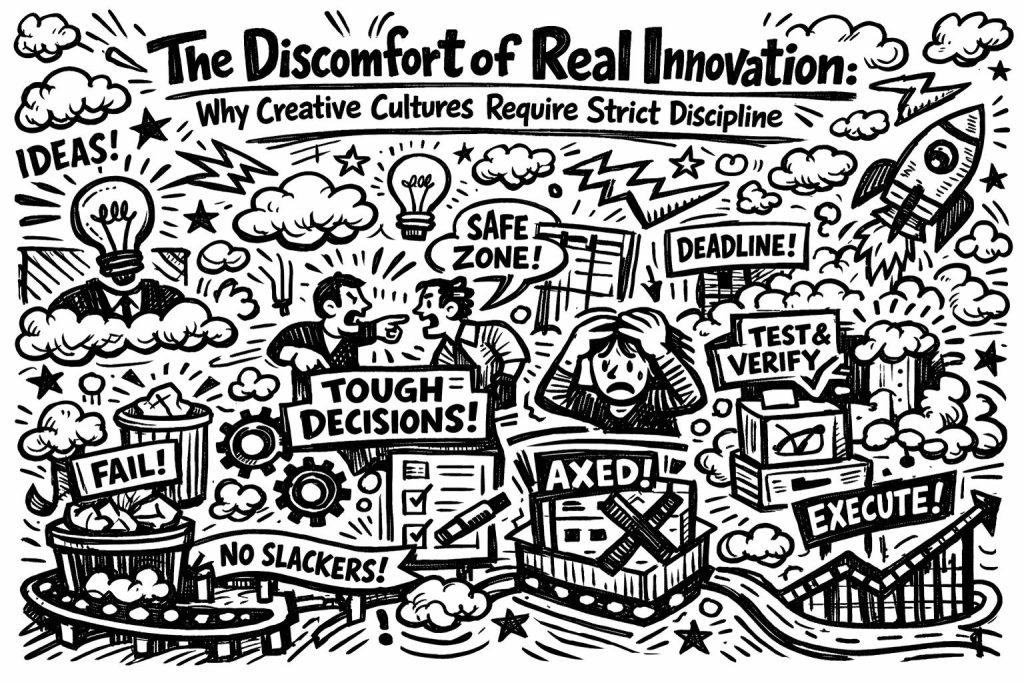
The Core Purpose of Innovation Teams
Every technology enterprise wants an innovation culture. The premise makes sense at a fundamental level: if you want people to solve complex engineering or market problems, they cannot operate in fear. Psychological safety, flat hierarchies, and a high tolerance for failed experiments are standard expectations across modern engineering hubs from Bangalore to San Francisco. We build these environments because we believe removing friction allows the best ideas to surface organically.
The presence of psychological safety, however, does not guarantee commercial value. An environment welcoming every brainstorm can become an incubator for mediocrity if there is no mechanism to filter the noise. We often mistake a lack of workplace friction for actual progress. The true mandate of an innovation culture is not to make employees feel validated in their creativity. Its purpose is to solve difficult, ambiguous problems that secure the future of the organisation.
Creativity is merely the starting point. Sustaining that creativity requires a foundation built on intellectual honesty rather than just social harmony.
The Mechanics of Intellectual Honesty
Translating raw ideas into viable products requires a distinct operational cadence. The actual mechanics of a high-performing R&D team rely on balancing contradictory forces. Teams need the safety to propose a flawed architectural concept, alongside the rigorous peer review necessary to dismantle it. Gary Pisano captured this dynamic well, noting that a tolerance for failure must be paired with an intolerance for incompetence.[1]
Leaders often struggle to separate the two. When a microservices migration fails because of an unforeseen integration bottleneck, that is a useful failure. The team explored a boundary and found a limit. When a deployment fails due to poor documentation or skipped testing protocols, that is an operational failure. Treating both scenarios with the same blameless attitude destroys accountability.
To manage this, technical leaders must draw a clear line between experimental dead-ends and execution missteps. Collaboration in this environment is rarely peaceful. It involves product managers and engineers arguing over technical debt versus feature delivery. The goal of management is to mediate these conflicts to ensure the best technical outcome, rather than simply aiming for team consensus. You want your engineers to challenge each other’s assumptions directly.
Structuring the Chaos
What does this discipline look like during a standard quarterly planning cycle? It means instituting structures that force difficult decisions early in the product lifecycle.
First, it requires aggressive project culling. Many organisations struggle to kill “zombie projects” that drain resources simply because a senior stakeholder championed them. A disciplined culture sets specific validation metrics before a single line of code is committed. If those user adoption or performance metrics are not met during the prototype phase, the project is shelved. The team then moves on without emotional baggage.
Second, funding and resource allocation must be treated as stage-gates. You fund the initial exploration phase with minimal oversight to encourage broad thinking. Once a concept requires scaling, the criteria for continued investment become rigid. Teams must present hard data, clear cost projections, and identified risk factors.
Innovation is a structured process of risk management. It requires leaders who create the space for open exploration while demanding absolute rigour in how those ideas are tested, funded, and ultimately shipped.
Footnotes:
[1] Gary P. Pisano, “The Hard Truth About Innovative Cultures,” Harvard Business Review, https://hbr.org/2019/01/the-hard-truth-about-innovative-cultures