
Hello, fellow curious minds! If you’ve ever looked at the world around you—the swirling clouds, the intricate patterns on a leaf, or even the chaos of a bustling city—and wondered how it all fits together, John Gribbin’s Deep Simplicity: Chaos, Complexity, and the Emergence of Life is a mind-expanding read.
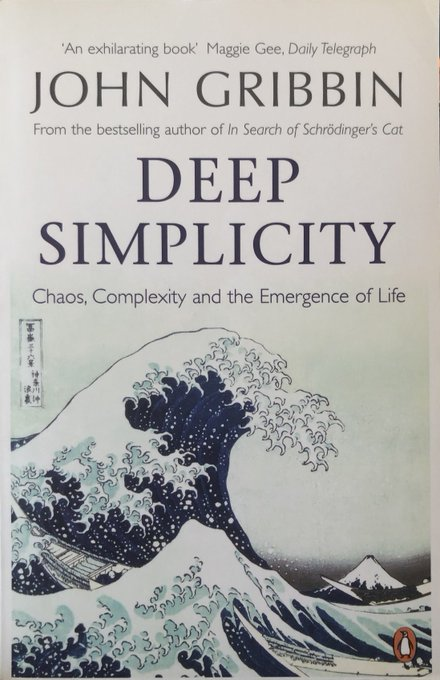
Published in 2004, this book takes us on a journey from the basic laws of physics to the origins of life itself, showing how simplicity underpins the most complex phenomena in the universe. Gribbin, an astrophysicist and science writer, weaves history, science, and philosophy into a narrative that’s both accessible and profound.
In this blog post, I’ll cover everything valuable from the book: its core ideas, chapter-by-chapter breakdowns, key examples, and even practical takeaways for everyday life. Drawing from book, we’ll explore how chaos isn’t just disorder—it’s the foundation of order, complexity, and life. Let’s dive in!
Why This Book Matters: The Big Picture
At its heart, Deep Simplicity argues that the universe isn’t as complicated as it seems. Simple rules, when combined with nonlinearity, feedback, and sensitivity to initial conditions, give rise to everything from weather patterns to living organisms. Gribbin traces this from Newtonian physics to modern chaos theory, emphasizing that life emerges naturally at the “edge of chaos”—that sweet spot between rigid order and total randomness.
The book bridges disciplines like physics, biology, and geology, showing how concepts like entropy, fractals, and power laws explain not just stars and atoms, but also earthquakes, extinctions, and even human societies.
Key Overarching Themes
Chaos from Simplicity: Deterministic systems can produce unpredictable outcomes.
Emergence: Complex wholes arise from simple parts interacting.
Life’s Origins: No supernatural leap needed; life self-organizes from chemical networks.
Gaia Hypothesis: Earth as a self-regulating system where life maintains habitable conditions.
Chapter Summaries: Deep Dive into Core Concepts
Chapter 1: Order out of Chaos
Gribbin starts with the historical quest to understand the universe’s order. Ancient views saw natural events as gods’ whims, but the scientific revolution changed that. Figures like Copernicus, Galileo, and Kepler laid the groundwork: Galileo with his experiments on motion and pendulums, Kepler with planetary laws. Newton synthesized this into universal gravitation and motion, creating a “clockwork universe” where everything is predictable if you know the initial conditions.
But cracks appear: The three-body problem (e.g., Sun, Earth, Moon) defies easy solutions, hinting at chaos. Thermodynamics introduces entropy—the measure of disorder—which always increases, giving time a direction (you can’t unbreak an egg). Boltzmann’s statistical mechanics shows how order can fluctuate locally, allowing complexity like life in an otherwise disorderly universe.
Valuable Insight: Science shifted from divine explanations to laws, but determinism has limits—chaos lurks in simple systems.
Chapter 2: The Return of Chaos
Here, Gribbin delves into thermodynamics and how entropy challenges Newtonian predictability. Systems probabilistically increase in disorder, but local decreases allow order. Poincaré’s work on celestial mechanics reveals the three-body problem’s chaos: tiny initial differences lead to wildly different outcomes, debunking Laplace’s perfect prediction dream.
Phase space visualizes system states, and Poincaré sections spot patterns. Non-linear systems, like weather, exhibit the “butterfly effect”—Edward Lorenz’s discovery that small changes (a butterfly’s wing flap) can cause storms. The solar system’s orbits are chaotic over long timescales, explaining asteroid impacts and potential extinctions.
Valuable Insight: Chaos undermines strict determinism; it’s why weather forecasts fail long-term, and it applies to everything from planets to populations.
Chapter 3: Chaos out of Order
Chaos isn’t random—it’s deterministic but unpredictable due to sensitivity. Examples: River turbulence shifts from stable vortices to chaos as speed increases; a dripping tap period-doubles (one drip, then two, four, chaotic). The logistic equation for population growth shows bifurcations leading to chaos at certain rates. Feigenbaum’s constant reveals universal patterns in these transitions. Strange attractors pull systems into fractal structures—self-similar patterns like coastlines or snowflakes, with non-integer dimensions (e.g., Koch curve at 1.26). Fractals describe nature’s irregularities, from blood vessels to mountains.
Valuable Insight: Simple rules generate infinite complexity; fractals show self-similarity across scales, linking math to the real world.
Chapter 4: The Edge of Chaos
Living systems thrive at the boundary between order and chaos, where dissipative structures form in non-equilibrium states (e.g., life uses energy to maintain order). Bénard cells in heated fluids create hexagonal patterns; Turing’s reaction-diffusion model explains biological patterns like zebra stripes or leopard spots via chemical “activators” and “inhibitors.” The Belousov-Zhabotinsky reaction demonstrates oscillating chemistry. In evolution, chaos’s edge allows mutations to drive major changes efficiently.
Valuable Insight: Complexity emerges from energy flows and simple interactions; this is key to morphogenesis and adaptation.
Chapter 5: Earthquakes, Extinctions, and Emergence
Complex systems break into interacting parts following power laws (e.g., Gutenberg-Richter for earthquakes: many small, few large). Fractal coastlines and self-organized criticality (like sandpiles avalanching) explain scale-invariance. Mass extinctions follow similar patterns, interconnected without needing cosmic catastrophes. Emergence: Life from non-life via autocatalytic networks (Kauffman); genes form cycles, leading to complexity from simplicity.
Valuable Insight: Power laws and networks show how small triggers cause big events; life’s emergence is a phase transition in connected systems.
Chapter 6: The Facts of Life
Evolution is a fact, explained by natural selection: inheritance, variation, competition. Examples: Darwin’s finches adapting beaks. Game theory’s evolutionary stable strategies (e.g., hawk-dove balance); Red Queen hypothesis for co-evolution. Fitness landscapes have peaks, but chaos enables punctuated equilibrium—long stability, sudden shifts. Ecosystems evolve to critical states; extinctions cascade via networks. Gaia hints at Earth’s unified system.
Valuable Insight: Evolution isn’t gradual; chaos and connectivity drive rapid changes and stability.
Chapter 7: Life Beyond
Inspired by Apollo views, Lovelock’s Gaia sees Earth as self-regulating: Life reduces entropy, maintaining conditions (e.g., oxygen levels). Daisyworld model: Daisies balance temperature via albedo. Algae’s dimethyl sulfide forms clouds, regulating climate. Ice cores show life’s role in CO2. Extraterrestrial life? Look for entropy-reducing systems.
Valuable Insight: Life and Earth co-evolve; simplicity underlies cosmic habitability.
Additional Valuable Gems from the Book
Beyond chapters, Gribbin highlights:
- DNA as a Recipe, Not Blueprint: Flexible instructions allow variation.
- Moon’s Role: Stabilizes Earth’s tilt, preventing chaotic climates.
- Free Will Illusion?: Chaos suggests unpredictability even in deterministic universes.
- Interdisciplinary Ties: Chaos in economics (stock crashes), traffic, and more.
“We are at home in the Universe… we are made in the image of the Universe itself.” — Kauffman (via Gribbin)
How to Implement These Lessons in Your Life
Gribbin’s ideas aren’t just theoretical—apply them!
Embrace the Butterfly Effect
Small daily changes (e.g., a 5-minute habit) can lead to big transformations. Track in a journal.
Live at the Edge of Chaos
Introduce variety (new hobbies) to spark creativity, but maintain routines for stability.
Use Feedback Loops
Review actions weekly; adjust like a self-regulating system.
See Networks Everywhere
Build connections; one outreach can emerge opportunities.
Reduce Personal Entropy
Organize spaces daily to create order amid life’s chaos.
Apply Power Laws
Focus on high-impact tasks; prepare for rare events with buffers.
Conclusion: Simplicity in a Complex World
Deep Simplicity reveals a universe where chaos begets complexity, and life is a natural outcome of simple laws. It’s empowering: We’re not adrift in randomness but part of an interconnected, emergent whole. If you’re into science, philosophy, or self-improvement, grab this book—it’ll change how you see everything.
What resonates most with you? Share in the comments! For more reads, check out Gribbin’s other works like “In Search of Schrödinger’s Cat.“
Stay curious!
Ready to Dive Deeper?
Get “Deep Simplicity” on Amazon – Explore the book that reveals how simplicity underlies the universe’s complexity!