
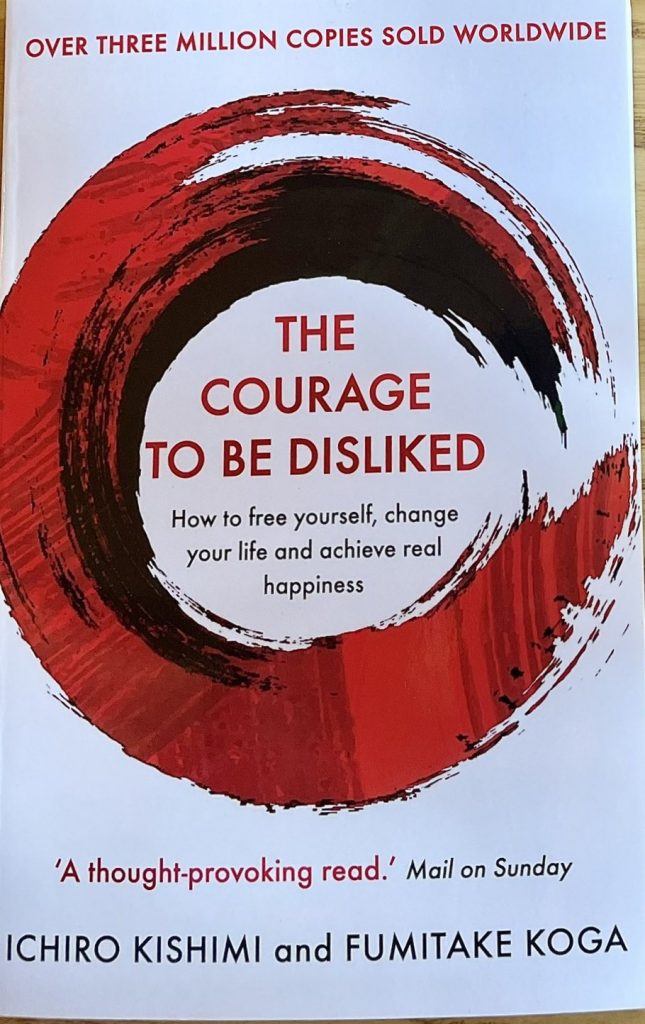
In an age of constant notifications and silent pressure to be “liked” by everyone, The Courage to Be Disliked offers a radically different definition of happiness: live by your own tasks and values, contribute to others, and accept that some people will not approve—and that’s okay. Rooted in Alfred Adler’s psychology, the book argues that you are not a victim of your past but an active creator of your present and future.
Grab the book here: Buy on Amazon
What This Book Really Teaches
The book uses a dialogue between a philosopher and a frustrated youth to unpack Adlerian psychology in simple, story-like form. Instead of analyzing childhood endlessly, it focuses on your current goals and choices—why you act the way you do right now, and what purpose that behavior serves.
Adler’s key move is teleology: behavior is guided by goals, not trapped by causes. That means even deeply rooted patterns (people-pleasing, perfectionism, inferiority feelings) can change once you accept responsibility and choose a different direction.
Core Adlerian Insights (Simplified)
Here are the big ideas your draft already captures well—now grounded in Adler’s framework and sharpened:
- You are not determined by your past: Your past is a story you tell yourself; you can assign it a new meaning that supports growth instead of limitation.
- All problems are interpersonal relationship problems: Most suffering comes from comparison, inferiority, and tangled expectations with others.
- Separation of tasks: Constant anxiety comes from trying to control what isn’t yours—especially other people’s opinions, choices, and emotions.
- Recognition vs contribution: Chasing praise creates fragile happiness; contributing to others creates a stable sense of worth and belonging.
- Community feeling: Genuine happiness grows from feeling part of a larger whole and acting from social interest, not self-centered competition.
Refined Key Insights
- You Are Not Defined by Your Past
The book doesn’t deny that painful events happened; it denies that they must dictate your present. Adler’s view is that you use past experiences as tools to achieve present goals—for example, staying “stuck” can be a strategy to avoid risk or responsibility.
💡 Example: A software developer once blamed their toxic childhood for struggling with confidence at work. But instead of staying stuck in that story, they chose to reframe it: “My difficult background taught me resilience and empathy. I can use these strengths to lead with understanding.” Within months, their approach to work shifted dramatically.
- All Problems Are Interpersonal Relationship Problems
💡 Example: A manager felt resentful that colleagues didn’t recognize her hard work. She spiraled in jealousy comparing herself to peers. Only when she shifted focus from “Why don’t they value me?” to “How can I build genuine connections with my team?” did everything change. By focusing on the relationship, appreciation naturally followed.
- The Courage to Be Disliked = Real Freedom
Freedom is not doing whatever you want; it is acting according to your own chosen tasks and values, even when it risks disapproval. Without this courage, life becomes a performance tailored to other people’s expectations.
💡 Example: A content creator wanted to start a YouTube channel but feared criticism. She realized she had a choice: hide her authentic self to avoid judgment, or share her truth despite potential dislikes. She chose courage. Her genuine voice attracted a loyal community that valued her perspective exactly because it was authentically hers.
- Separation of Tasks: The Most Practical Tool
Almost every toxic pattern—micromanaging, people-pleasing, social anxiety—comes from mixing up tasks. Asking “Whose task is this?” immediately reduces emotional overload and conflict because you stop carrying what is not yours.
💡 Example: An anxious employee constantly worried about her boss’s mood and tried to control team members’ opinions to keep everyone happy. This created more stress. When she realized “My boss’s mood is not my task, my team’s opinions are not my task,” she could finally focus on her actual responsibilities. Her anxiety dropped, and paradoxically, her relationships improved.
- Drop the Hunger for Recognition
Recognition is addictive: you get a hit from praise, then need more to feel okay. Adlerian psychology proposes “horizontal” relationships where everyone is equal in dignity; you encourage, collaborate, and contribute instead of dominating or seeking status.
💡 Example: A consultant spent years crafting presentations seeking praise from executives. When she stopped focusing on “Will they think this is brilliant?” and instead focused on “Does this solve the real problem for my client?,” her work paradoxically became more appreciated. And more importantly, she finally enjoyed her work.
- Happiness = Self-Acceptance, Trust, and Contribution
Adler highlights three pillars: accepting yourself as you are, trusting others instead of assuming hostility, and contributing to your community. When these three align, the need for constant external validation weakens dramatically.
💡 Example: A software developer struggled with low self-worth, always comparing himself to “smarter” colleagues and withholding help out of fear. When he accepted himself as “good enough” and started mentoring juniors, something shifted. Contribution filled a void that external validation never could. His confidence grew from within, not from metrics.
- Live in the Here and Now
The book rejects the idea that life is a waiting room for a “better future.” You practice happiness through present actions that express your chosen lifestyle, not through imaginary future milestones.
💡 Example: A parent spent weekends worrying about “Will my kids succeed in the future?” instead of being present for their childhood. After reading this principle, she changed her internal question to: “What can I do right now to make this moment meaningful?” She stopped planning ahead and started living. Her children felt the difference.
7-Day Starter Plan (Then Scale to 30 Days)
Use the practical action items as the base, but structure them into a short, repeatable program. This makes the post uniquely actionable.
Day 1: Map Your Current Tasks
- List 3 recurring situations that drain you (work conflict, family expectations, social media anxiety).
- For each, write: “What am I trying to control here that isn’t my task?” (e.g., others’ approval, their mood, their decisions).
Day 2: Practice Task Separation in Real Time
- When you feel triggered, pause and mentally ask: “Whose task is this actually?”
- If it’s about someone else’s reaction, consciously step back: focus on what you can say/do with integrity, then release the outcome.
Day 3: One Act of Contribution Without Credit
- Do one helpful act where no one can link it back to you: share a resource, give feedback privately, support a colleague quietly.
- Reflect: “How did this feel different from seeking recognition?”
Day 4: Replace Praise/Rebuke With Encouragement
- In 3 interactions today, avoid judging language (“good job”, “you failed”) and use encouragement instead (“You showed up consistently”, “I see your effort”).
- Notice how this shifts relationships from vertical (superior–inferior) to horizontal (equal–equal).
Day 5: Design a “Here and Now” Ritual
- Pick one daily activity—tea, commute, walk—and turn it into a 10-minute present-moment ritual without screens.
- During it, ask: “If happiness is available only in this moment, what does ‘living well’ look like right now?”
Day 6: Reframe One Old Story
- Take one painful memory you often revisit.
- Write the old story (“Because this happened, I can’t…”), then write a new, teleological story: “Given this happened, what purpose can I choose for it now?”
Day 7: Choose One Ongoing Lifestyle Direction
- Define one “lifestyle” you want to live (for example: “a contributing teammate”, “a calm parent”, “a creator who shares honestly online”).
- List 2 small, daily behaviors that express this lifestyle without needing anyone’s approval. Commit to them for the next 30 days.
Repeat and deepen these practices over four weeks: more task separation, more anonymous contribution, less recognition-seeking, and one or two lifestyle-aligned actions every day.
Why This Book Is Worth Your Time
The Courage to Be Disliked is not gentle self-help; it will challenge your favorite excuses and the comfort of blaming the past. Critics are right that it can sound harsh on trauma, so it should complement—not replace—professional help where needed.
But if you’re ready to trade people-pleasing and overthinking for responsibility, contribution, and authentic living, this book gives you a clear psychological framework plus tools you can use immediately.
Adler called his approach a “psychology of courage” because applying these ideas requires bravery—bravery to let go of excuses, face change, and embrace ordinary, authentic living. For professionals juggling multiple priorities, dealing with impostor syndrome, or struggling with perfectionism and approval-seeking, Adler’s ideas are a lifeline.
Ready to start? Grab your copy here: Buy on Amazon, pick one action from the 7-day plan, and begin practicing the courage to be disliked today.
What insight resonates most with you? Start with one action item now—the courage to change begins right here.