
Enterprise Solution Architecture: Frameworks, Levels, and Best Practices
Enterprises do not fail because of bad code; they fail because of misaligned intent. A company might have a brilliant product vision, but without a clear map connecting that vision to the actual servers, networks, and databases it runs on, engineering efforts scatter. We see this frequently when traditional organisations attempt large-scale cloud migrations or digital transformations. They authorise massive budgets, but without structural discipline, they end up with a “lift-and-shift” disaster—replicating their legacy bottlenecks in a more expensive cloud environment.
This is the exact problem Solution Architecture (SA) solves. It is the fundamental practice of translating a high-level business mandate into a predictable, buildable reality. We rely on solution architecture to ensure that every infrastructure instance spun up, every microservice deployed, and every API exposed directly serves the organisation’s core objectives. Without this discipline, technology stacks fragment, technical debt compounds, and operational costs spiral out of control.
Defining the Architecture Landscape: The “How”
To achieve alignment, technology leaders must clearly differentiate between the macro vision and the micro execution. The journey begins with Enterprise Architecture (EA) before narrowing down to individual solutions.
Enterprise Architecture: The City Plan
Think of Enterprise Architecture as a city planner’s zoning map. It dictates the overarching technology vision for the entire organisation, aligning IT investments with long-term business goals. The primary objective is to control costs through shared services and standardisation. Depending on the age and scale of the organisation, this macro-structure typically follows one of two foundational patterns:
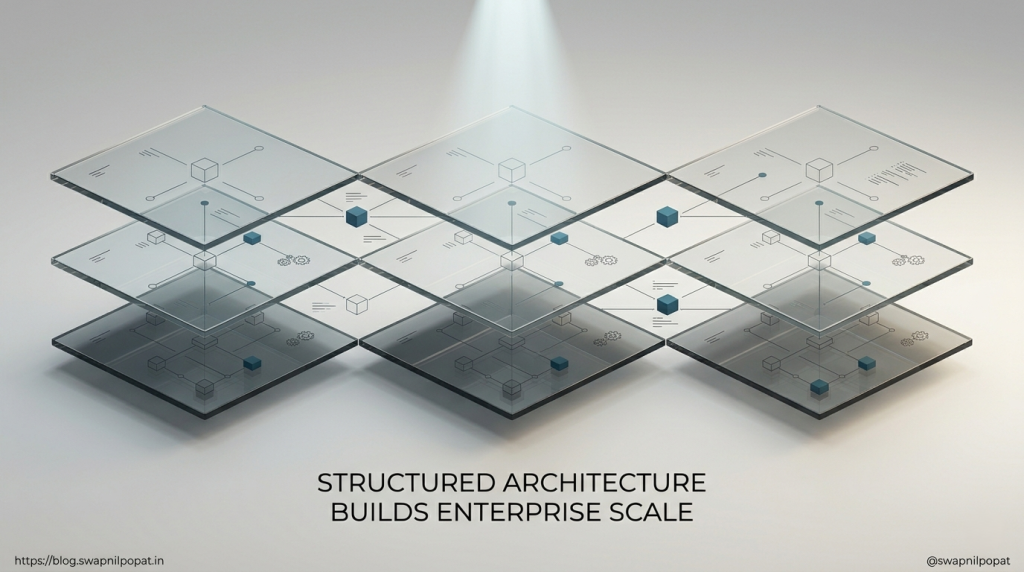
- Layered Enterprise Architecture: Often seen in established institutions like legacy banks or large telecom operators, this organises the company into strict, horizontal layers. It typically comprises the Experience layer (consumer-facing mobile and web applications), the Process layer (domain-specific business logic and services), the Systems layer (core databases, mainframes, and systems of record), and a cross-cutting Governance layer (shared security, logging, and monitoring).
- Microservices-Based Enterprise Architecture: This approach is essential for “brown-field” environments—companies carrying heavy legacy systems that need to innovate at the speed of modern fintechs. Instead of replacing the old system overnight, architects introduce an Anti-Corruption Layer (ACL) and API gateways. The ACL acts as a translator, allowing modern, decoupled microservices to interact with older monolithic applications without adopting the legacy system’s outdated data models or constraints.
Solution Architecture: The Building Blueprint
While the EA provides the zoning rules, the Solution Architecture is the detailed, mathematical blueprint for a specific building within that city. A single enterprise vision will inevitably spawn dozens of distinct solution architectures.
The methodology relies heavily on architectural patterns. These are tested frameworks capturing the hard-won experience of senior practitioners. Reusing a proven pattern—like an Event-Sourced architecture for transaction processing or a Strangler Fig pattern for migration—ensures a team avoids failing twice for the same reason. You take an established structure, understand its historical failure modes, and adapt it to your current project constraints. This saves hundreds of hours of design time and protects the project budget.
Architects follow a deliberate workflow to move these solutions from concept to code. When a business unit proposes an idea to improve efficiency, an architecture review board first evaluates its technical and financial feasibility. If the project clears this hurdle, architects design the core structural levels, often initiating a Proof of Concept (POC) to validate third-party vendor software before formally handing the completed blueprint over to the engineering teams for execution.
The Three Levels of Design: The “What”
A complete solution architecture delivers absolute clarity across three distinct operational planes. These are not merely conceptual drawings; they are tangible deliverables that provide the exact parameters the implementation team needs to begin building.
Level 0: Business Architecture
This level strips away technical jargon to map stakeholder interactions and business value. The goal is to create a document that a Chief Marketing Officer and a Lead Developer can both understand perfectly.
If we examine a core banking application, a Level 0 diagram simply illustrates a retail customer using a mobile phone to access a secure gateway, which then routes requests to internal banking systems. Even at this highest level of abstraction, the architect must identify three non-negotiable structural requirements:
- A method of entry: An API Gateway to channel incoming traffic.
- A method of data exchange: An Integration tier to connect disparate backend services.
- A method of user verification: An Identity and Access Management (IAM) module to secure the perimeter.
Level 1: Technical Architecture
Abstract business needs now translate into specific software functions and vendor selections. That secure gateway identified in Level 0 now demands precise technical specifications: it requires rate throttling to prevent DDoS attacks, caching to reduce backend load, and a developer portal for third-party integrations. The integration tier requires data transformation logic and service orchestration.
Here, architects map these functional requirements to actual vendor products or open-source tools. For instance, they might evaluate WSO2 or Kong for API management, MuleSoft for integration, and Auth0 or PingIdentity for security.
This phase forces the classic “build versus buy” decision. Buying commercial off-the-shelf software offers a turnkey setup that accelerates time-to-market, but it risks vendor lock-in and high recurring licensing fees. Building from best-of-breed open-source components preserves architectural independence and operational control, but at the cost of extended development cycles and the need for highly specialised internal engineering talent.
Level 2: Deployment Architecture
This is the physical or cloud infrastructure reality. It moves past software logic into hard capacity planning, network topologies, and resource estimation.
Consider a retail mobile service expecting 200 requests per second (RPS) during a Diwali flash sale. The architect cannot simply provision servers for 200 RPS. They must calculate the downstream multiplier effect. An initial API call to view a product catalogue might trigger two internal database queries, a call to a pricing engine, and a ping to an inventory microservice. Therefore, the underlying integration tier needs capacity for at least 800 to 1000 RPS. Architects use these metrics to design multi-node clusters deployed across multiple Availability Zones (e.g., AWS Mumbai regions) to ensure high availability and disaster recovery.
Implementation Realities: The Omni-Channel Scenario
To see this framework under pressure, consider a complex omni-channel banking rollout. The mandate is to provide identical transaction capabilities across internet banking, SMS, physical ATMs, third-party banking agents, and regional call centres.
The architecture must expand significantly beyond basic mobile APIs. It introduces:
- Workflow Engines: Processes like home loan approvals cannot be handled by simple, synchronous API calls. They take days, require human intervention, and span multiple departments. The architecture requires a state-managing workflow engine (like Camunda) to orchestrate these long-running processes without timing out.
- Compliance and Identity: Handling financial data across multiple channels requires an Identity Server that complies with stringent data localisation regulations (such as RBI guidelines in India) or global standards like GDPR.
- Analytics and Telemetry: To track customer drop-offs across these varying channels, the architecture must pipe telemetry data into a centralised cloud analytics platform, allowing the business to measure the actual return on investment.
Timelines, Execution, and Ownership
The Solution Architect does not simply hand over a diagram and walk away; they remain a critical stakeholder throughout the entire project lifecycle, which typically follows a structured, iterative timeline:
- Weeks 1–4 (Definition): The architect collaborates with business analysts to define the L0, L1, and L2 architectures. The primary output here is clarity and budget approval based on accurate infrastructure estimations.
- Weeks 5–14 (Execution): While software engineers write the core logic, DevOps engineers build the continuous integration and continuous deployment (CI/CD) pipelines. QA engineers configure automated testing environments based on the performance metrics defined in the Level 2 architecture. The architect oversees this to ensure the build matches the blueprint.
- Weeks 15–16 (Go-Live): Feature sets are strictly frozen. The team executes safe deployment strategies. Instead of a risky “big bang” release, they might use Blue-Green deployments (running the old and new systems in parallel environments to allow immediate rollback) or Canary releases (routing just 5% of user traffic to the new system to monitor for anomalies). Vendors are placed on high alert for support escalations.
Ultimately, enterprise scale requires clear boundaries of ownership. Enterprise Architects and CTOs own the macro vision and the city plan. Solution Architects and Business Analysts own the translation of that vision into the L0, L1, and L2 blueprints. Software and QA engineers own the execution and the code that makes it real. When these roles align around a structured architectural framework, the technology finally begins to serve the business, rather than the other way around.